Sunday, March 17, 2019

Russell's Cabins, 1950

During the period between the 1930s and 1950s, before motels became popular, tourists passing through Middleborough were provided accommodation in overnight camps and tourists cabins, many of which lined Route 28 from North to South Middleborough. Among them was Russell’s Grove Cabins which stood on the now vacant parcel opposite Lorenzo’s, later the site of Rae’s Colonial Gift Shop.

 The property, a former woodlot owned by Levi O. Atwood of Rock, was acquired in May 1934 by Durell and Gladys J. Russell who eventually transformed it into a delightful roadside grove intended to lure tourists to stay for the night in a cabin set among the trees. In addition to the cabins, the Russells also conducted a small restaurant as part of the operation.

 Tourists of the era were less demanding than today and the cabins afforded a simple, affordable and pleasant solution for travellers’ needs a indicated by one postcard sent by Helen in July 1950 to her friend, Mrs. Mattie Quinn at Hudson Falls, New York.

“Sunday night, Dear Mattie and All, These are the cabins we are staying at tonight. We drove 233 miles today. Have double beds. Have bed all to myself. We just had a wonderful dinner and are now out on the enclosed porch. X marks our cabin. We made wonderful time. We are only about 80 miles to drive tomorrow. Love to you all. Helen.”

In April 1956, the Russells sold the cabins and retired to Florida.


Saturday, March 3, 2018

Otis Briggs House (1876)


The gable of the Otis Briggs House (1876) is visible behind the later addition that long housed Steve's Sports Den.
  
     A house on the site of 147 Center Street is first recorded as having been occupied in 1846 by Mrs. Susan Erpell (Erpelle), the widow of C. H. C. Erpell about whom very little is known. During Mrs. Erpell's occupancy, the immediate neighborhood was strictly residential with no businesses to speak of. A mention of the apparently well-tended Erpell property from 1857 describes what must have been a delightful yard with a "garden of myrtle between [the house] and the sidewalk and three mammoth cherry tress standing in the outer edge of the sidewalk."
    Mrs. Erpell died about 1863 at which time the property passed through her will to Lydia R. Thompson of Middleborough.  She in turn sold the ¾ acre property to Alden Miller of Middleborough on April 27, 1870, for the sum of $1,800.  At the time, this section of Center Street remained residential with the Bourne and Weston Houses occupying the lots where the Glidden building now stands. 
    Miller lived in the house only a short time, before disposing of it on June 3, 1872, to Salome K. Coombs of Lakeville, wife of James M. Coombs, editor of the Middleboro Gazette.  At the time of the sale, in addition to the house, another building (in all likelihood a barn) was standing on the property and was included in the conveyance.  The Coombses lived there briefly before relocating to a more prestigious address on South Main Street.  The Coombses may have been prompted to move by the increasing commercialization of Center Street at this time.  Although residential dwellings continued to be built along the stretch of Center Street between School Street and present-day Everett Square, the construction in 1874 of a new manufactory to house the Leonard & Barrows shoe manufacturing firm immediately to the west of the Erpell House on the corner of Center and Pearl Streets may have been somewhat off-putting.

Briggs Stable Token
     Mrs. Coombs sold the property in March, 1875, to Nancy W. Briggs, wife of Otis Briggs (1837-1911) of Middleborough.  Briggs, a noted liveryman, was undoubtedly eager to buy the property for the same reasons the Coombses were probably inclined to sell: the growing commercialization of Center Street.  The Erpell estate had an advantageous location situated as it was nearly mid-way between the business center at Middleborough Four Corners and the depot on Station Street, and it permitted Briggs to become the largest horsedealer in Middleborough during the last quarter of the nineteenth century.  At the time of the sale, the local press had clearly been cognizant of the property’s business potential: “The ‘Erpelle’ estate is offered for sale for the simple reason that the owner has other prospects.  It is a piece of real estate of which may be justly claimed a prospective value, being centrally located on the line of travel of the people, and just the place for a dry goods house or manufactory.”
      Briggs had since the age of eighteen been “prominently identified with the horse business”, first at East Middleborough and later at the Center Street location.  It was here that Briggs operated a sale and livery stable until his death, being Middleborough’s largest horse dealer for nearly half a century.  Briggs “had a wide acquaintance throughout this section, and was considered an expert judge and handler of horseflesh.”
     Many of Briggs’ horses were acquired in Vermont and sold through the Center Street stable which held a high reputation locally.  “…Perhaps most of the horses sold in town are those brought down from Vermont by Mr. Otis Briggs, who has his agent constantly on the lookout for the best animals, and a walk through his stables will suffice to show that he has a handsome well selected lot of horses”, noted one local newspaper in the 1870s.
     Briggs’ business trips were the frequent subject of news items carried in the local papers, and the horses procured in Vermont were eagerly awaited.  “Otis Briggs, one of our larger dealer in horses, harnesses, carriages, etc., and who always has a good turnout for one who desires a pleasant drive, is now in Vermont, purchasing horses for several of his customers.  We expect to see some fancy steppers.”  Perhaps not a “fancy stepper”, but no less a fine animal was the 1,250 pound Vermont-bred horse which Briggs sold in late 1882 to the Colby estate in neighboring Taunton. 
     The outstanding quality of Briggs’ selections was reflected throughout the era in the prices for which his horses ultimately sold and Briggs was believed to have “handled more high priced horses than any other man in New England.”  In July, 1877, Briggs received ten horses, six of which he sold within two days and one of which was valued at $1,000.   Many of the horses traded were Morgans, a breed particularly admired by Briggs who brought them from Vermont breeders by the railroad “carload”.  Briggs was also associated with the trotting interests in town, being affiliated with the operation of the Fall Brook trotting park on Cherry Street where standardbreds were raced for a number of decades at the close of the nineteenth century.  In his youth, Briggs had owned and apparently trained a number of standardbred horses, “among them Mountaineer, Victor E., Archie B. and Baby Lambert.  With improved speed devices some of these would doubtless have come close to the 2-minute mark.” 
     A year after acquiring the Erpell property, Briggs, in 1876, entirely refurbished the estate.  In the spring of that year, Briggs purchased the 30 by 50 foot so-called “old part” of the barn of James E. Peirce on South Main Street and had it relocated to the northwest of the house on Center Street where it was used to house his extensive livery business.  Shortly thereafter, Briggs contracted with a Mr. Woodbury to remove the former Erpell stable (probably the second building mentioned in the 1872 deed between Alden Miller and Salome Coombs), the physical work of moving the stable being done by Charles Tinkham in early September, 1876.
     Also at this time, Briggs constructed a new house upon the property.  The Middleboro Gazette noted in October, 1876, that “Otis Briggs has begun in earnest upon his residence, on the Erpelle estate”, and another notice the following month mentions “parties now building the dwelling house for Otis Briggs.”  The design of the house including its relatively high foundation wall (which would have intentionally raised the house above the mud and muck of the stable yard) support this date.  Still later that year, in November, Briggs engaged James F. Eldridge to sink a well on the property.  Undoubtedly, the changes were financed by Briggs’ lucrative trade and are reflective of those affordable by a relatively well-to-do businessman.
     Eventually, Briggs moved into other areas of business, most likely recognizing just what the arrival of the automobile portended for his livery business.  In 1906, Briggs acquired the large three-story woodframe School Street School which had been built in the 1850s, and had it relocated the following year onto his property where it was “remodeled into stores and tenements.”  At the time, Briggs’ large stable was extensively altered by contractor George W. Starbuck of Middleborough and put to use, according to fire insurance maps of the period, as a roller skating rink.  Additionally, a portion of a small structure known as the “old Erpell Building” (probably the original Erpell House) between the stable and the Briggs House was taken down at this time in order to accommodate the relocation of the schoolhouse.  Following the removal of this structure, Starbuck erected onto the front of the Briggs House a new store building measuring 28 by 32 feet to be occupied by E. H. Stetson (which firm temporarily occupied the eastern end of the old Erpell Building during the summer of 1907).  This new store building was later described as having three stores occupying three stories.
Staircase, Otis Briggs House (1876)
     Briggs died in 1911, and his widow (and his son Alton E. Briggs, the owner of the property after 1920), continued the commercial development of the site, so valuable had it become for these purposes.  The years surrounding 1900 had seen the construction of the Sullivan Block (now Glidden Building) and Pasztor & Klar’s bakery immediately to the east, and the conversion of the properties on the opposite south side of the street to business use as well.  In 1939, Joseph LaPlant, Jr., of Brookline briefly took possession of the Briggs property which was owned by Ray C. Johnson of Boston between 1939 and 1947.  It was during Johnson’s ownership that a small portion of the property was conveyed to Ermioni A. Savas for the construction of a package store.
     In 1947, the property which then included the Briggs House and the market building which stood in front of it, the former School Street School, the former Briggs stable (which had been moved) and a warehouse/garage which stood (and remains) at the rear of the property, was acquired from Johnson by antique and used furniture dealers Thomas B. Nichols and C. Ernest Aubrey who demolished the former stable.  The antique business of Nichols and Aubrey occupied the premises during the 1940s and early 1950s when they were succeeded by the Kearney sisters.  On January 29, 1954, the eastern-most portion of the property including the Briggs house was conveyed to Stephen C. Stanley of Middleborough.  Since that time, the house has been used as storage for the business operated by Stanley, Steve’s Sports Den.


Monday, February 12, 2018

Woolworth's


The F. W. Woolworth Company (Woolworth’s) first came to Middleborough in 1911, establishing a store in the American Building on South Main Street as Middleborough’s first chain department store. Increasing business prompted the company to have a building built to its own specifications on Center Street in 1927-28 (the building most recently occupied by Reedy's Archery), replacing the James Soule House which had originally stood on the site. This new building was built the same year that Woolworth’s principal Middleborough competitor W. T. Grant arrived in town. 

The building was purpose built for Woolworth's to that company's specifications by Arthur Shactman of Brookline, the owner of the property in 1927-28. Woolworth's proposed leasing the building for a period of 20 years commencing May 1, 1928 and ending May 1, 1948, with an annual rent of $3,600 for the first 10 years and $3,900 for the remaining years. In return, Woolworth's required the building to be "the same in workmanship and materials as the premises now occupied by the lessee at 297-297A Harvard Street, Brookline, Massachusetts." Specifications for the building were incorporated directly into the lease between Shactman and Woolworth's.
 
Woolworth’s occupied the southern store in the multi-store building. (The northern store in the block was occupied initially by the Park Cafe). In 1948, Woolworth's expanded to occupy the entire building and remodelled thoroughly in 1957.

Woolworth's closed its Middleborough store on December 24, 1971.

Tuesday, February 6, 2018

Winter Scene, c. 1923


A 1920s blizzard has tied up hapless motorists on South Main Street. The sole landmark recognizable today is the Central Congregational Church, the steeple of which can be seen plastered with snow. The buildings on the left have all since been replaced by what is now the Rockland Trust Company. At the time the building at the far left housed Williams' Specialty Shop, a business conducted by Harold Williams (later of Williams' Trading Post). The view is looking from the Four Corners.

Saturday, January 27, 2018

First Holy Communion, Sacred Heart Church, 1890s


The original Sacred Heart Church was built in 1881 following Archbishop John Joseph Williams' blessing of the cornerstone on July 12, 1881. The church stood on Center Street approximately on the site today occupied by the church rectory and parking lot.

Prior to the construction of the church, the community's Catholic residents worshipped in private homes as well as the upper floor of the P. H. Peirce grocery store (now the Middleborough Police Station). Mass was celebrated by visiting priests and the first recorded Mass in Middleborough was celebrated in the home of Patrick Sullivan on Wareham Street in 1852.

Here a group of children celebrating their first Holy Communion have gathered for the photographer. The girls are attired in white dresses, veils and gloves while the boys wear their best suits. Several proud parents look on.

 Though the image is undated, it appears to be from the 1890s.


Friday, January 26, 2018

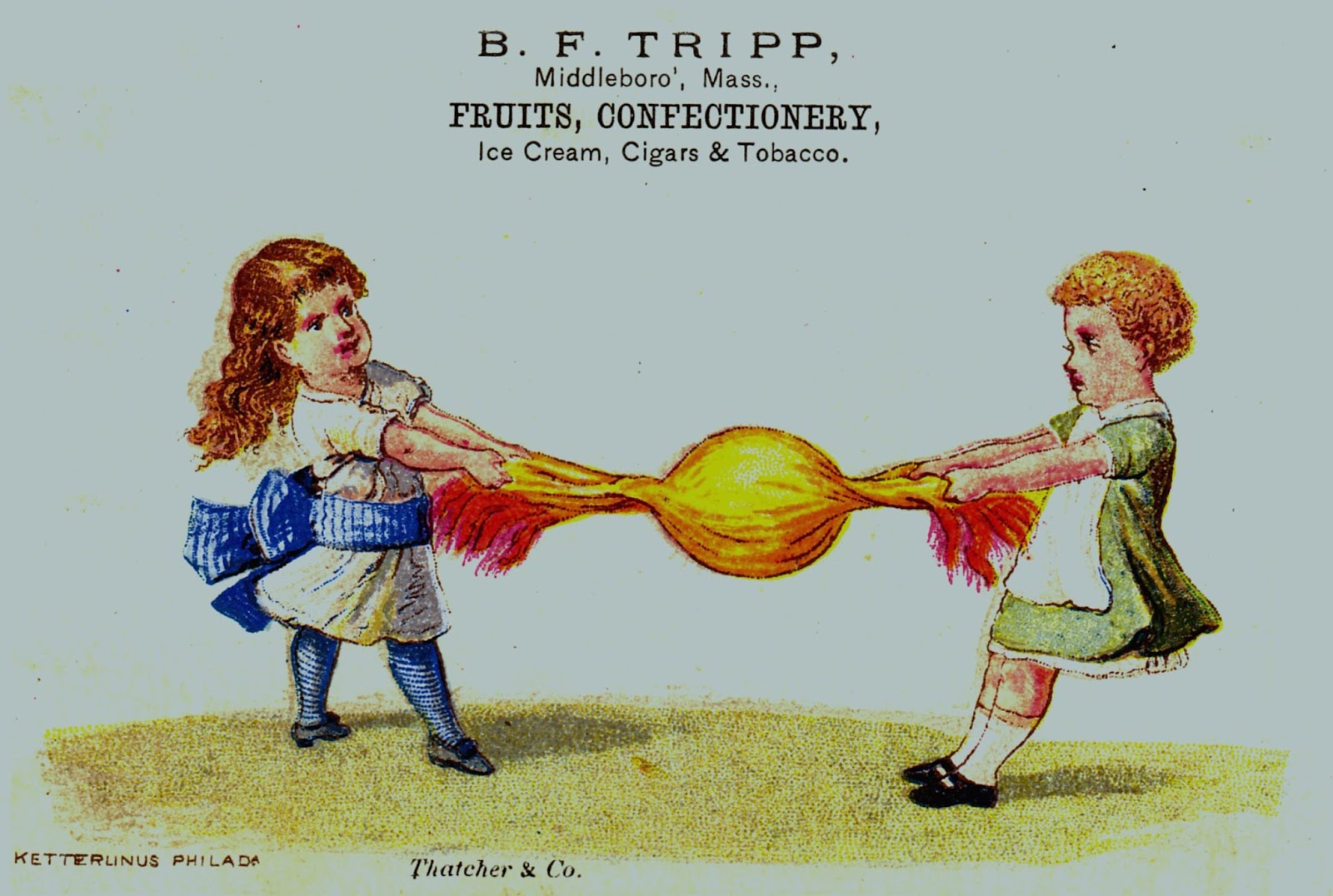
B. F. Tripp Trade Cards


Trade cards were a popular means of advertising during the late 1800s. Small and highly-colored, these illustrated cards became widespread with the introduction of color lithography in the 1870s and their free distribution helped retailers and manufacturers advertise their goods. The cards were frequently changed by merchants, helping entice shoppers back for a return visit. Children often collected the cards, pasting them into bound volumes, and they remain highly collectible today.

One Middleborough merchant who made wide use of trade cards for advertising was Benjamin F. Tripp, who conducted a combined ice cream, confectionary, fruit and cigar store on the site now occupied by Kramer Park next to the former Savings Bank Building on Center Street. Tripp utilized many different styles of cards which would have been purchased in bulk and printed by a local printer (most often Thatcher & Company) with Tripp's specific information.

The samples below from the collection of Recollecting Nemasket provide a glimpse of the variety of trade cards offered by Tripp's.


Sunday, December 3, 2017

Nemasket Spring Water Company Drivers


In order to deliver its products, the Nemasket Spring Water Company required several drivers. From left to right are Sulo Jussila, Albert Malefant, George Chilian, Edmund Rondelli, Stan Sinoski and Armen Kayajan. With business reaching a new peak n 1937, the plant began 24-hour operation, requiring a fleet of 10 trucks to deliver its product throughout southern Massachusetts.

Nemasket Spring Bottles


During the 1930s, Nemasket Spring on Plymouth Street produced a variety of beverages, producing under its own name as well as the Cape Cod brand. Early in the decade, the firm bottled its sodas and mixers in pressed green glass bottles manufactured to resemble cut glass. Later, simpler clear bottles were used for bottling the Cape Cod brand sodas. During the mid-1930s, the firm also produced unflavored carbonated water retailed in heavy glass soda siphons, a development likely fostered by the repeal of Prohibition in December 1933.

Bottles from the collection of Recollecting Nemasket. The Cape Cod brand bottle still contains the original cola.

Wednesday, November 22, 2017

What would the Pilgrims have Thought?


This tidbit from the Brockton Enterprise of August 24, 1912 indicates that the cranberry truly was king in Middleborough, the harvest that year even postponing a traditional local meeting of churches.

   "There isn't going to be a meeting of the Plymouth County neighborhood convention of the churches next month because of cranberries.
   "That sounds rather strange, but Gen. Sec. A. H. Wardle of the [Middleborough] Y. M. C. A., who is secretary of the convention, announces this to be the reason for missing the September meeting.
   "Ordinarily the sessions are resumed in September after the vacation period, and it was expected the same custom would be in effect this year....
   "But it didn't happen. The active members of these churches are so busy gathering up cranberries, which literally translated means money, that they can't stop to entertain church delegates, Mr. Wardle states, so the meeting will go over till October.
   "It is said to be the first time the convention failed to resume its meetings in September, and the reason assigned is considered a very unusual one."

Source: Brockton Enterprise, "Cranberry is King, Religious Convention is Postponed", August 24, 1912.
  

Tuesday, October 31, 2017

Workmen Unearth Human Skull, 1931

Here's a Hallowe'en tidbit from the pages of the November 20, 1931 Middleboro Gazette.

Workmen Unearth Human Skull

   Mystery surrounds the gruesome finding of a human skull by Calvin R. Hosford, Albert Carr and Fred Blanchard yesterday morning as they were excavating for a small building on the new state highway [Route 28] on East Grove street on Mr. Hosford's property. As the men were digging towards the wooded section, the skull, which was but a few feet under ground came rolling down into the loosened sand. Although the men kept digging there were no human bones found.
   Chief of Police Sisson was called and to him was delivered the skull which was brought to the police station and viewed by Medical Examiner A. V. Smith. It was large and broad and had been in the ground a long time and was evidently from a man of more than middle life. The teeth were wide and heavy and a worn space in the side showed the man to be a smoker having gripped his pipe tightly.
   A checkup was started by the police, but as far as they can learn there have been no missing persons reported for years and in the absence of any more bones of a human skeleton and marks of identification the case does not promise any solution. There were no marks of violence which rather explodes any murder theory from head injuries at least, but its depth under the ground also dispels any suicide angle.
   The case will probably find its way into the archives of the police as one of those unsolved mysteries you have read about.

   The location of the discovery was on Hosford's property known in deeds as the "Sharing Brook Lot", a portion of which is now occupied by The Cabin restaurant (formerly the Log Cabin). Despite the rareness of unearthing human remains and the even greater curiosity of discovering an incomplete human skeleton, the news was "buried" on page 4 of the newspaper.

Saturday, October 28, 2017

Lorenzo's 1971


Before Lorenzo's built a dining room in 1972, sit-down dining at the West Grove Street Italian restaurant meant a snappily-uniformed car-hop who brought your meal to you in your car. Although car-hop service is a thing of the past, Lorenzo's remains a Middleborough landmark. Here the staff and owners Lorenzo and Geraldine Grosso have assembled for a picture in 1971.

Sunday, July 30, 2017

Bicycle! Bicycle!

"I want to ride my bicycle, I want to ride my bike. I want to ride my bicycle, I want to ride it where I like."

Bicycling as a recreational pastime and a means of transport flourished in late nineteenth and early twentieth century Middleborough. Not all were pleased with this development, however, including resident curmudgeon James A. Burgess who wrote the following to the Middleboro Gazette in 1908 regarding "Reckless Bicycle Riders":

"I have a few words to say on the recklessness of bicycle riding and what rights the human family has to the highway today. Under the old common law the highway belongs first to the person on foot, but the thing has been reversed, and today he is the last person who has any rights on it. And what rights has he?

"The bicycle rider has come and come to stay. He rides more on the sidewalks in this village and town than he does anywhere else, outside a small section in the centre. Take for instance the sidewalk across the rear of the town house lot. It is safe to say that five bicycle riders out of six ride on that walk. And I am told that women who live in that section don't pretend to come out, much less to attempt to cross it evenings....

"Tuesday night, upon crossing [the Four Corners], I was hit by a bicycle rider and thrown flat upon my back. The young man did not stop to see if I was injured, which I was not. He is known. Now if he will call around and see me, I will apologize for being in his way and guarantee that I will never be there again if I can help it."

Fortunately for Burgess, the bicyclists pictured here confined their riding to the rural precincts with the Green being a conspicuous locale.

Bicyclist, Middleborough Green, 1912.
For many like the gentleman pictured here, bicycles represented a relatively inexpensive means of transportation. Automobiles had not yet been popularized and, like horses, remained expensive and impractical for many young industrial workers who found employment in local factories. Meanwhile, trolleys and the steam railroad were limited in geographic scope. The bicycle, however, allowed individuals the freedom to explore and travel.
 

Middleborough bicycle enthusiasts, photograph by John A. Belden, c. 1900.
The two women pictured here represented a new generation of bicycle riders. Previously many women had been much dependent upon male relations to convey them about so the bicycle represented a new independence for them. Susan B. Anthony maintained that bicycle-riding had "done more to emancipate women than anything else in the world."
 

Lady bicyclist, Middleborough Green, late 1800s
Women bicyclists were sometimes criticized for riding about the countryside unescorted which some found shocking. More dismaying for conservative-minded individuals was the adoption of bloomers by lady bicycle riders which made riding both safer and easier. The woman pictured here, however, remained more modestly dressed in her ankle-length skirt. Such skirts, however, required a different design for women's bicycles and explains why the top tube (or brace) on the frame of a woman's bicycle was substantially lower than on bicycles ridden by their male counterparts. 

Friday, July 28, 2017

Battis Field Dedication

The following souvenir scorecard was distributed as part of the dedication celebration for Battis Field, November 8, 1941.


Tuesday, May 2, 2017

Lakeville Trolley Scare, 1910


Find it difficult to retrieve change you drop down between the seat and the console in your car? Well here’s a bit of unnerving news from 1910 Lakeville.

Dynamite Scare.

Passengers Fled from Car Near Lakeville.

Workmen Dropped Stick of Explosive, but No One Hurt.

Excitement prevailed on the electric car from Elliott’s Corner [East Taunton] to the Lakeville town house [October 31] afternoon, when it was discovered that a workman who was on his way to New Bedford had dropped a stick of dynamite between the window sash and the car seat. The stick of the explosive was small and just fitted in the slot where the window slides down between the side panels of the car.

It was noticed that the workman was trying to recover something from the small cavity, and when asked by conductor Cornell what he was doing he answered that he had dropped a stick of dynamite in there.

The passengers at once became panic-stricken. Motorman Frazer and the conductor thought of the wires concealed there and saw visions of the car and passengers going up in the air. It was decided to stop the car and allow the passengers to walk to the town house, a short distance away.

The car was run slowly to the car barn five miles away, extra precaution being taken against any great jar. Master mechanic Edward Robinson fished the stick out with a wire, and it was exploded in the woods in the rear of the station.

The passengers, after recovering from their fright, took the next car to [Middleborough]. Traffic was delayed only a short time while a car was being substituted.

Illustration:
Lakeville trolley car with Lakeville Town House in the background, c. 1900. The trolley mentioned in the article would have been an enclosed trolley that typically replaced the open trolley pictured here which was used during the warmer months.

Source:
Boston Globe, "Dynamite Scare", November 1, 1910.

Saturday, November 26, 2016

Middleborough High School Popularizes Football

Football emerged as a popular sport in Middleborough in the late 1800s, largely through the efforts of Middleborough High School students who formed the first teams in town. The school itself initially provided little direction or organization. Teams were formed informally by the students who, as recorded by newspaperman James H. Creedon, were responsible for engaging their own coach and establishing their own schedules in conjunction with other teams in the region. It is through the work of these boys that football was popularized locally. These early roots ultimately led to the growth of semi-professional football in Middleborough when in 1939 the forerunner of the successful Mitchell Memorial Club Cobras was formed. The highly successful team, now simply the Middleboro Cobras, continues to fulfill the community’s passion for the sport as part of the Eastern Football League as does the local high school team.
 

The 1905 Middleborough High School squad poses for a team photo. As is evident from the makeshift uniforms in the photograph, the team was, like many of the school’s earliest teams, informally organized. Students made do with what they could cobble together including quilted pants and cotton knit sweaters. Noticeable is the absence of protective gear such as helmets and pads, though five of the boys have noseguards which were uncomfortable to wear and  were eventually replaced by facemasks starting in the 1920s.  


Practices were held regularly in the large open field in the rear of Middleborough High School which then occupied the South Main Street school building which was later and better known as the Bates School. In the background, the Episcopal and Baptist churches are conspicuous with Center Street seen in the far distance.
 

Pictured is the 1908 Middleborough High School team including George Jones, Charlie McCarty, Frank Harrington, Ralph Mendall, Brad Swift, Bill Andrews, Russell Perkins, Everett Clough and Charles Lang. Future Superintendent of Schools J. Stearns Cushing sits in the center and holds the ball marked ’08. “Mel” Gammons, standing in the back row, second from the right, was a noted all-round athlete who was instrumental in the formation of the Middleborough High School basketball team, a sport at which he excelled. The year following this image, the high school was unable to organize a football team, but had sufficient interest in 1910 to field two squads.

Thursday, January 28, 2016

Thomas Panesis, c. 1925


Thomas Panesis in his canopy express truck, circa 1925.

As part of the fruit and produce business Panesis conducted in Middleborough, delivery wagons and later trucks were operated. The photo depicts Panesis in what is believed to be the GMC truck he acquired in June 1922. (Four years later, in June 1926, he added a Chevrolet delivery truck).
Panesis had poor luck with both the wagons and trucks. In August 1915 his delivery wagon was struck by an auto and in July 1919 Forest... Washburn ran into Panesis' fruit wagon with his motorcycle. In February 1927 Robert E. Nolan's touring car collided with Panesis' truck on Everett Street.

The location is the corner of Benton and Webster Streets with 28 Webster Street being noticeable in the background.

Panesis Fruit Store, 1906

 
The photograph is of the original Center Street fruit store of Greek immigrant Thomas Panesis (who appears second from the right).

Panesis entered the fruit selling business at Taunton in 1899 and later became familiar with Middleborough where he operated delivery carts following 1901. In 1906, Panesis relocated to Middleborough, occupying a small building which stood between the Middleborough Savings Bank Building and B. F. Tripp's ice cream parlor and which had been constr...ucted in 1895 by L. P. Thatcher for use by George F. Bryant as a coal office.

In addition to the great variety of fresh fruit sold by the Center Street firm (a portion of which is displayed here), tobacco and candy were also available and in 1909 a cigar case was added in the small space. Fresh roasted peanuts were also retailed (even following mid-June 1909 when the peanut roaster at the store exploded, injuring employee Peter Zamfes). Residents of the period would long afterwards recall the smell of freshly roasted peanuts wafting from the store. So successful was the business that in late 1909 Panesis was compelled to rent additional space elsewhere in Middleborough for storage. Ultimately, in 1913, Panesis relocated his business to a larger building on the opposite side of Tripp's where it remained for another three-quarters of a century, becoming a Middleborough institution.

Although this photograph is marked "1907 May 30" at the bottom, a different photograph which was clearly taken on the same day and which appears in Mertie E. Romaine's History of the Town of Middleboro, Massachusetts, is labelled July 4, 1906, the more likely date. The Middleborough Savings Bank Building is recognizable on the left of the picture while the window on the right advertising ice cream, Moxie and Coca-Cola belongs to Tripp's.

Bob's Diner


The diner that stood at the Four Corners between 1939 and 1973 was built upon the site of a wood-frame building that had stood there since before 1800. That building was demolished by Alphonse D. Fish who installed a new diner on the site in December 1939. Kenneth Keedwell initially leased the diner which was later operated as Bob’s Diner and Emery’s.

 In July 1973 the diner was demolished, the Middleboro Gazette reporting at the time: “The first major change in the ...appearance of the Four Corners for some years was in progress this week as demolition of the former ‘Bob’s Diner,’ more lately known as ‘Emery’s,’ got under way. An auction, held at the corner lot Monday to clear the contents of the diner, added to the activity as workers broke up the diner and an addition built on some time ago. Razing of the diner provided employment for several of the youths who have frequented the corner”.

Don Ayotte and Gary Correia constructed the replacement building that now occupies the location.

Andrew B. Gibbs

A large number of Middleborough residents continued to engage in agriculture well into the twentieth century, including Andrew B. Gibbs (1854-1937) pictured here. Gibbs operated a farm and dairy on Tispaquin Street for many years in the late 1800s and early 1900s and it is from him that Garabed Kayajan purchased his milk business in 1920. The oxen beside Gibbs were a welcome addition to any farm as they were capable of plowing, threshing grain and drawing heavy loads.

Thursday, January 14, 2016

May Flower Lodge A. F. & A. M., 75th Anniversary Program, 1939