Showing posts sorted by date for query hathaway, soule & harrington. Sort by relevance Show all posts

Wednesday, February 23, 2011

Hathaway, Soule & Harrington Ephemera

Carole Tracey, great granddaughter of Savory C. Hathaway, founder and senior partner of the Hathaway, Soule & Harrington shoe manufacturing firm which operated a plant on Cambridge Street in Middleborough between 1887 and 1900 has generously shared the following pieces of business stationery from the firm.


Hathaway, Soule & Harrington envelope, 1882.  Courtesy of
Carole Tracey.
Among the firm's earliest logos was that shown here on one of
the firm's envelopes, depicting a man's high-top button shoe. 
This style remained a staple of the firm for a number of years.
At the time this envelope was used, the firm maintained its
offices in Boston.


Hathaway, Soule & Harrington letterhead, 1897.  Courtesy of
Carole Tracey.
The stylized H, S & H logo with the entwined banner was a
trademark which the firm used during the 1890s to mark its product.
It featured frequently in the firm's advertising and communications,
helping brand the firm's high quality products in the mind of the
buying public.


Hathaway, Soule & Harrington business stationery engraving
(detail), late 19th century-early 20th century.  Courtesy of
Carole Tracey.
This high-style engraving was typical of the attention 19th
and early 20th century businesses devoted to promoting their
operations.  The view depicts Hathaway, Soule & Harrington's
three shoe manufactories, including the Middleborough plant
(at the far left).  The plant is seen from the southwest with the
railroad tracks in the foreground and Cambridge Street out of view
at the opposite end of the building.

Friday, December 17, 2010

Hathaway, Soule & Harrington Operatives


At its peak, Hathaway, Soule & Harrington’s Middleborough branch is said to have employed about 200 operatives. While no definitive records exist detailing exactly who was employed in the plant, town directories for 1895, 1897 and 1899, combined with the federal census record of 1900, are useful in creating a partial list of operatives during the final years of the branch plant’s operation, as well as the roles which they occupied within the factory.

Not surprisingly, given their lack of transportation, most operatives of Hathaway, Soule & Harrington needed to live close by the factory. The presence of the plant provided impetus for the residential growth of the district north of Everett Square and east of Cambridge Street during the last two decades of the nineteenth century. By the mid-1890s, certain streets within the district had become closely wedded to the plant. Most notable was Everett Street itself where one out of every two households had a member employed by the firm.  Frequently, more than one family member was employed by the firm, a circumstance which further strengthened the connection between industry and community within the neighborhood.
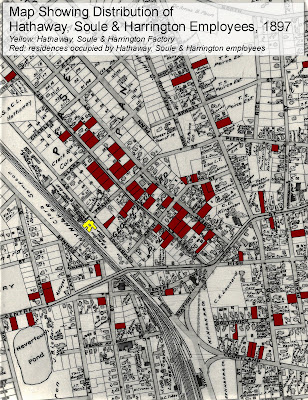

The rapid growth of a residential neighborhood, in turn, promoted commercial development within the district. The Spooner Block on the northeast corner of Everett and Arch Streets was constructed at this time and the inclusion of a grocery on its first floor provided nearby residents with a store within walking distance. Still other businesses were established around Everett Square at what was then known as Middleborough’s West End (in distinction to the West Side on the opposite side of the railroad line). These developments created a closely knit community where residents not only lived and shopped together, but worked closely together, as well. 

There are no known records detailing the closure of Hathaway, Soule & Harrington’s Middleborough plant, but it is likely to have been both financially and emotionally devastating at the time, given the dependence much of the neighborhood had upon the firm for its livelihood. Though HS&H offered its Middleborough operatives positions in the New Bedford plant it seems that few accepted. Among them was Wilkes H. F. Pettee, the engineer of the Middleborough plant, who temporarily joined Hathaway, Soule & Harrington at New Bedford before returning to Middleborough in 1906 when he took a position with the George E. Keith Company which opened a local branch in that year. Most former Hathaway, Soule & Harrington operatives however remained at Middleborough where they were likely absorbed into the workforces of Alden, Walker & Wilde which opened in 1900; Leonard & Barrows which was expanding its workforce at the time; and Leonard, Shaw & Dean. Additionally Brockton remained an alternative for many and several former Hathaway, Soule & Harrington operatives relocated to that city where the larger number of shoe manufactories promised greater opportunity and seemingly better job security.

List of Middleborough Residents Employed by Hathaway, Soule & Harrington

1895

Names and addresses are taken from Resident and Business Directory of Middleboro and Lakeville, Mass. (Needham, MA: A. E. Foss & Co., 1895).  Occupations are noted where listed in the directory. Boarders are listed as “bds.” followed by the name of the person with whom they boarded (which in most cases was a parent).

Andrew Alden, superintendent, 149 Center
Arthur H. Alden, foreman stitching room, 64 Everett
J. Gardner Alden, 42 Forest
George E. Aldrich, 73 Everett
Eunice A. Allen, bds. Nathaniel L. Allen 6 Elm
Charles E. Ashley, 45 Vine
George Henry Bailey, bds. George Bailey 10 Myrtle
Harry Banwell, 12 Arch
Ella F. Baker, bds. Marcus M. Thompson 7 Everett
Earl G. Besse, Jr., East Main
Isaac P. Breach, 13 Everett
William E. Bryant, Plymouth
Andrew P. Bunker, 78 Everett
Luke Callan, 11 Clifford
Luke F. Callan, bds. Luke Callan 11 Clifford
Herbert L. Caswell, 67 Cambridge
S. H. Caswell, 56 Vine
Henry H. Chace, 18 Pearl
William B. Chandler, 55 Everett
William F. Chandler, bds. William B. Chandler 55 Everett
Nellie M. Chickering, bds. Edgar W. Tinkham 61 Everett
Will L. Chipman, 5 West
David R. Clark, overseer, 4 Forest
John M. Conant, bds. Isaac Shaw 15 Everett
Walter A. Coombs, 12 Southwick
Charles H. Crandall, night watchman, 9 Lane
John H. Cronan, bds. Andrew Cronan 67 Vine
Asa F. Crosby, Jr., bds. Asa F. Crosby 10 West
Joseph H. Crosby, bds. Asa F. Crosby 10 West
Carrie Cudworth, bds. Mrs. Annie Lloyd 18 Southwick
William Curran bds. Mrs. Hannah Stevens 41 Forest
Messup David, 9 Cottage Court
Flora M. De Maranville, bds. Mrs. Eliza J. De Maranville 270 Center
Nellie F. De Maranville, bds. Mrs. Eliza J. De Maranville 270 Center
James Dorigan, bds. Cornelius Dorigan 55 Vine
Gertrude Drew, bds. William H. Downey 147 Center
Ellis D. Dunham, 27 Elm
Henry A. Eaton, 53 Everett
George Egger, 15 Arch
Philip L. Egger, bds. Philip Egger Plymouth Street
Charles A. Englestad, 238 Center
Walter Farmer, bds. Thomas A. Churbuck 44 Forest
Leon B. Farrington, 18 Everett
J. Emma Finney, bds. Mrs. Isabel H. Finney 131 Center
George Fosberg, bds. Charles F. Fosberg 19 East Main
Ansel Fuller, 10 Webster
Charles F. Fuller, bds. Albert S. Sparrow 2 Lincoln
Herman W. Fuller, bds. Ansel Fuller 10 Webster
Frank Gardner, bds. Mrs. Hannah Stevens 41 Forest
William H. Goodwin, 77 North Main
Leonard W. Gurney, bds. James L. Gurney 10 Arch
Wilson T. Harlow, bds. Mrs. Lucinda A. Harlow 33 Courtland
Eugene Hathaway, bds. Mrs. Ella E. Estes 12 Frank
Israel T. Hathaway, 13 North
Samuel Hathaway, 29 Courtland
Alvin Hayward, bds. Albert S. Sparrow 2 Lincoln
Arthur A. Holmes, bds. Theodore P. Holmes Grove
W. Frank Holmes, bds. Albert H. Merrihew 10 West
William F. Holmes, bds. Theodore P. Holmes Grove
Waldo E. Jackson, bds. Mrs. Clara Jackson 200 Center
Mabel E. Jefferson, bds. James M. Jefferson 15 West
August P. Johnson, bds. John M. Johnson 70 Forest
George H. Keedwell, 79 Water
Saul Labonte, bds. Mrs. Ella E. Estes 12 Frank
George Henry Lakey, bds. Rodney I. Ellis [boarding house] 104 Center
Mattie C. Landers, bds. William Lumberd 5 Southwick
James E. Leggee, bds. Henry J. Leggee 6 Lovell
Orville N. Leonard, 16 Arch
John L. Luippold, bds. John M. Luippold 17 Arch
Lizzie A. Luippold, bds. John M. Luippold 17 Arch
Charles A. Mabry, 23 Elm
Mary A. Maker, bds. M. Jennie Francis, 54 Everett
Edgar Mason, bds. Rufus J. Brett 14 Forest
Eugene H. McCarthy, 171 Center
Mrs. L. F. McFarland, 85 Forest
Oliver Nichols, 65 Oak
Robert E. Nolan, bds. William Nolan 28 Montello
James J. O’Hara, laster, 48 Vine
Fred A. Orcutt, bds. J. Carter
George Perkins, bds. Mrs. B. F. Johnson [private boarding house] 19 South Main
George A. Perkins, foreman packing-room, boards Mrs. B. F. Johnson [private boarding house] 19 South Main
Hannah M. Perry, bds. Mrs. Narcissa A. Perry Plymouth
Mary L. Perry, bds. Mrs. Narcissa A. Perry Plymouth
Arthur W. Petersen, bds. Rodney I. Ellis [boarding house] 104 Center
Maggie E. Plunkett, bds. Peter Plunkett 49 Vine
Mary A. Plunkett, bds. Peter Plunkett 49 Vine
Emily M. Pratt, bds. Silas Pratt 6 Barrows
William B. Rafuse, 9 Courtland
Myron F. Raymond, bds. Marcus M. Raymond 3 Lincoln
Robert N. Raymond, 73 Everett
Esther Rees, bds. 66 Everett
S. Everett Ryder, Plymouth near the Green
Alfred A. Shaw, stitcher, 41 School
C. Henry Shaw, 22 Pearl
Elmer F. Shaw, 32 Arch
Lewis W. Shaw, 156 Center
Marcus A. Shaw, bds. Samuel Shaw
May F. Shaw, bds. Frank H. Shaw 56 School
Alice Shay, bds. Asa C. Bennett 12 Arch
Lucy Sheehan, bds. Thomas B. Sheehan 16 East Main
Mary Sheehan, East Main
John L. Shepherd, 152 Center
Katie M. Sherman [Shuman], bds. Arthur H. Alden 64 Everett
Mamie F. Sherman [Shuman] bds. Arthur H. Alden 64 Everett
Wilford Shuman, bds. Arthur H. Alden 64 Everett
C. Alice Shurtleff, bds. Virgil W. Shurtleff 11 Lovell
Joseph B. Simmons 30 School
Annie Smith, bds. Mrs. Annie Lloyd 18 Southwick
L. M. Smith, bds. Wilkes H. F. Pettee 59 Everett
Martin Smith, 13 Rock
Fred Southwick, 23 Arch
Harry Staples, bds. Thomas A. Churbuck 44 Forest
John J. Sullivan, 229 Center
Mrs. Mary J. Sullivan, 174 Center
John H. Swift, 62 Forest
Henrietta D. Taylor, bds. Mrs. Elizabeth Taylor 91 Oak
Marcus M. Thompson, 7 Everett
William W. Tinkham, bds. B. Frank Tinkham 75 Oak
Clifford L. Vaughan, bds Mrs. Helen F. Vaughan 9 Oak
Foster Wade, bds. Ezekiel H. Aldrich 14 Barrows
Nelson C. White, 57 Everett
William H. Wilde, supt., bds. Mrs. Frances Wilde 34 Pearl
Thomas E. Wilmot, 16 Everett
Kenelm Winslow, 14 Pearl

1897

Names and addresses are taken from Resident and Business Directory of Middleboro, Massachusetts: For 1897 (Needham, MA: A. E. Foss & Co., 1897).  Occupations are noted where listed in the directory. Boarders are listed as “bds.” followed by the name of the person with whom they boarded (which in most cases was a parent).

Andrew Alden, superintendent, 24 Forest
Arthur H. Alden, foreman stitching room, 64 Everett
J. Gardner Alden, 42 Forest
Eldon L. Aldrich, bds. Ira F. Aldrich Arlington
George E. Aldrich, 73 Everett
Ira F. Aldrich, Arlington
Eunice A. Allen, boards Nathaniel L. Allen 68 Forest
Obed D. Allen, bds. Nathaniel L. Allen 68 Forest
Charles E. Ashley, laster, 269 Center
Charles Bagamian, bds. 62 Arch
Harry Bagamian, 62 Arch
Harry Banwell, bds. 12 Arch
Ella F. Barker, bds. M. M. Thompson 7 Everett
James P. Bolton, stitcher 63 Everett
Edward Bonney, 105 South Main
Charles Borden, bds. 287 Center
Ezra J. Bourne, cutter 35 Courtland
Ella F. Bowker, bds. 7 Everett
William E. Bryant, Plymouth
Andrew P. Bunker, 78 Everett
Luke Callan, 11 Clifford
Luke F. Callan, bds. Luke Callan 11 Clifford
Mary Casey, stitcher, bds. Hannah Casey 13 Montello
Mary E. Casey, bds. 13 Montello
Annie A. Chace, bds. 88 Oak
Henry H. Chace, 18 Pearl
William B. Chandler, 55 Everett
William F. Chandler, bds. W. B. Chandler 55 Everett
Nellie M. Chickering, bds. Edgar W. Tinkham
David R. Clark, overseer, 16 Forest
John M. Conant, bds. 15 Forest
Walter A. Coombs, 12 Southwick
John H. Cronan, bds. Mrs. Ann Cronan 67 Vine
Joseph H. Crosby, bds. 10 West
Messup David, 9 Cottage Court
Flora M. De Maranville, bds. Mrs. Eliza J. De Maranville 270 Center
Nellie F. De Maranville, bds. Mrs. Eliza J. De Maranville 270 Center
Katie Doherty, bds. Neal Doherty 22 Everett
Mary J. Doherty, bds. Neal Doherty 22 Everett
James Dorigan, bds. 55 Vine
Gertrude Drew, bds. W. H. Downing 49 Everett
Ellis D. Dunham, 27 Elm
George A. Earle, 66 Everett
Emma A. Eaton, bds. Henry A. Eaton 53 Everett
Francis R. Eaton, leather cutter, 14 Rock
Henry A. Eaton, 53 Everett
Nellie F. Eaton, bds. Henry A. Eaton 53 Everett
George Egger, 15 Arch
Philip L. Egger, bds. Philip Egger Plymouth
James A. F. Elliot, bds. Lillian B. Elliot 63 Water
Charles A. Englested, 238 Center
Henry A. Farrington, 5 Southwick
Leon B. Farrington, 18 Everett
J. Emma Finney, bds. Mrs. Isabel H. Finney 77 Everett
George Forsberg, bds. Charles F. Forsberg 19 East Main
Emma L. Francis, 54 Everett
Ansel Fuller, 10 Webster
Herman W. Fuller, bds. Ansel Fuller 10 Webster
Stephen S. Gibbs, 17 Everett
William H. Goodwin, 17 Pearl
Annie Gurney, bds. James L. Gurney 10 Arch
Leonard W. Gurney, bds. James L. Gurney 10 Arch
Wilson T. Harlow, bds. Mrs. Lucinda A. Harlow 33 Courtland
Samuel Hathaway, 29 Courtland
Alvin Hayward, bds. Albert S. Sparrow 62 Everett
Maria D. Herman, bds. George H. Herman 244 Center
Elmer E. Holmes, bds. Theodore P. Holmes Grove
William F. Holmes, 15 Oak
Charles Horton, 66 Everett
Waldo E. Jackson, bds. Mrs. Clara Jackson 200 Center
August P. Johnson, bds. John M. Johnson 70 Forest
Henry W. Keith, stitcher, 35 Cambridge
Saul Labonte, bds. 117 Center
Mattie L. Landers, bds. 54 Everett
Ferdinand Landgrebe, North
Saul Lebonte, bds. 33 Pearl
Henry J. Leggee, laster, 7 Lovell
James E. Leggee, bds. Henry J. Leggee 7 Lovell
John L. Luippold, bds. John M. Luippold 17 Arch
Lizzie A. Luippold, bds. John M. Luippold 17 Arch
Carrie Mann, bds. 88 Oak
Edward Mason, bds. 14 Forest
Eugene H. McCarthy, 53 Everett
Sampson McFarland, bds. 54 Everett
William A. Merrihew, 23 High
Oliver Nichols, 273 Center
Arthur Nickerson, 15 Everett
Robert E. Nolan, bds. William Nolan 28 Montello
James J. O’Hara, laster, 48 Vine
Fred A. Orcutt, bds. J. Carter Plymouth
Ellen P. Penley, bds. Mrs. Priscilla S. Penley, 68 Everett
Josiah F. Penniman, laster, 23 North
Hannah M. Perry, bds. Mrs. Narcissa A. Perry Plymouth
Mary L. Perry, bds. Mrs Narcissa A. Perry Plymouth
William H. Perry, 12 Elm
Wilkes H. F. Pettee, engineer, 38 Forest St
Willie Phinney, bds. 54 Everett
Mary A. Plunkett, bds. Peter Plunkett 49 Vine
William B. Rafuse, 106 Everett
Frank C. Raymond, laster, 113 South Main
Myron F. Raymond, bds. Marcus M. Raymond Myrtle Avenue
Robert N. Raymond, 73 Everett
Charles W. Ricker, bds. Union House Center
Albert Rogers, bds. 55 Everett
Charles M. Rounds, bds. M. A. Leahy 19 Everett
Herbert H. Ryder, bds. A. F. Ryder 25 North
Sadie P. Ryder, bookkeeper, bds. Mrs. Jane P. Ryder 28 Peirce
Alfred A. Shaw, stitcher, 55 Forest
Lewis W. Shaw, 78 Forest
Marcus A. Shaw, bds. Samuel Shaw 19 Center
May F. Shaw, bds. F. H. Shaw 56 School
Mary Sheehan, 16 East Main
Levi Sherman, 50 Forest
Mary F. Sherman, bds. Levi Sherman 50 Forest
Wilford Shuman, bds. 33 Pearl
C. Alice Shurtleff, bds. Virgil W. Shurtleff 16 Arlington
Fred Southwick, 23 Arch
Harry E. Staples, 71 Everett
John J. Sullivan, 229 Center
Mrs. Mary J. Sullivan, 174 Center
Harry Swift, bds. Mrs. William H. Swift 8 Forest
John H. Swift, 62 Forest
Henrietta D. Taylor, bds. Mrs. Elizabeth Taylor 91 Oak
Marcus M. Thompson, 7 Everett
William W. Tinkham, bds. B. F. Tinkham 75 Oak
Foster Wade, bds. E. H. Aldrich 14 Barrows
Nelson C. White, 57 Everett
William H. Wilde, clerk, 33 Pearl
Thomas E. Wilmot, 16 Everett

1899

Names and addresses are taken from Resident and Business Directory of Middleboro’ and Lakeville, Massachusetts, For 1899. (Needham, MA: A. E. Foss & Co.,1899). Birth dates and occupations are taken from the Federal census taken in June, 1900, two months following the closure of Hathaway, Soule & Harrington. Shoe manufacturing required skilled workers and shoe operatives typically remained within their area of expertise. It therefore may be presumed that the occupation listed for each operative in June, 1900, was the same occupation that worker pursued while employed by Hathaway, Soule & Harrington. Boarders are listed as “bds.” followed by the name of the person with whom they boarded (which in most cases was a parent).

Andrew Alden (b. 1838), foreman, 24 Forest

Arthur H. Alden (b. December 1864), supt., 64 Everett

J. Gardner Alden (b. January 1862), stitcher, 42 Forest

Eldon L. Aldrich (b. January 1878),”sole laying”, bds. Ira F. Aldrich Arlington
He relocated to Brockton with his father, Ira F. Aldrich, and family following the closure of HS&H.

Ira F. Aldrich (b. 1862), laster, Arlington
He relocated to Brockton following the closure of HS&H.

Ervin O. Allen (b. April 1874), finisher, bds. Nathaniel L. Allen 29 School

Eunice A. Allen (b. August 1876), bds. Nathaniel L. Allen 29 School

Obed D. Allen (b. September 1872), treer, 68 Forest

Charles E. Ashley, laster, 254 Center

Harry Banwell (b. March 1863), treer, 54 Pearl

Charles J. Bopp (b. December 1881), burnisher, bds. Mrs. Elizabeth Bopp 92 Oak

Charles Borden (b. December 1879), bds. Charles G. Borden, 72 Water
Following the closure of HS&H he took work as a day laborer.

Mary E. Boucher (b. December 1862), stitcher, bds. Thomas Boucher 144 Center

Ezra J. Bourne, cutter, 35 Courtland

Ella F. Bowker (b. March 1867), stitcher, bds. 7 Everett
The Bowker family removed to Kingston following the closure of HS&H.

Luke Callan (b. September 1837), 11 Clifford
He took work as a day laborer following the closure of HS&H.

Luke F. Callan (b. January 1873), laster, bds. Luke Callan 11 Clifford

H. Percy Caswell (b. June 1867), upper leather cutter, 16 Barrows

Henry H. Chace B. June 1858), upper leather cutter, 18 Pearl

William B. Chandler (b. September 1845), Goodyear sewer, 25 Forest

Alberto F. [Albert W.] Chase, (b. October 1879), shoe worker, bds. Mrs. Clara A. Chase 6 Coombs

Lizzie M. Chase (b. May 1881), shoe worker bds.Mrs. Clara A. Chase 6 Coombs

Nellie M. Chickering (b. June 1867), skiver, bds. Edgar W. Tinkham 61 Everett

Fred F. Churbuck, cutter, 18 Webster

David R. Clark (b. December 1842), overseer, 18 Forest

Harry L. Clark (b. 1874), cutter, bds. Nelson Thomas Tispaquin

Roy C. Coombs (b. September 1878), sole cutter, bds. William A. Coombs 24 East Grove

Walter A. Coombs, 12 Southwick

John H. Cronan (b. December 1869), shoemaker, bds. Mary Cronan 67 Vine

Othello E. Dean (b. November 1865), laster, 22 Pearl

Harry A. De Maranville, 143 South Main

Flora M. De Maranville (b. August 1872), bds. Mrs. Eliza J. De Maranville 270 Center

Nellie F. De Maranville (b. October 1869), shoeworker, bds. Mrs. Eliza J. De Maranville 270 Center

Katie Doherty, bds. Neal Doherty 3 Station

James Dorigan (b. November 1866), shoemaker, 55 Vine

Elmer O. Drew (b. January 1875), “moulding (shoe)”, 11 Barrows

Gertrude I. Drew, bds 10 Elm

Ellis D. Dunham (b. January 1841), trimmer, 27 Elm

Morton W. Dunham (b. June 1878), 285 Center

William L. Dunham (b. October 1869), heeler, 32 Webster

George A. Earle, 66 Everett

Emma A. Eaton (b. August 1874), stitcher, bds. Henry A. Eaton 53 Everett

Francis R. Eaton, leather cutter, 14 Rock

Henry A. Eaton (b. December 1838), heel finisher, 53 Everett

Nellie F. Eaton (b. August 1861), stitcher, bds. Henry A. Eaton 53 Everett

George Egger (b. April 1860), finisher, 15 Arch

Philip L. Egger, bds. Philip Egger Plymouth

Henry A. Farrington (b. September 1864), “tacker on”, 5 Southwick

Leon B. Farrington (b. September 1870), sole leather cutter, 24 West Grove

Emma J. Finney (b. October 1854), skiver, bds. Mrs. Isabel H. Finney 77 Everett
She removed to Brockton with her mother and sister (who was a stitcher) following the closure of HS&H.

George Forsberg, 55 Everett

Emma L. Francis (b. February 1857), vamper, 54 Everett

Nelson T. Frank, bds. 18 Webster

Ansel Fuller (b. September 1834), “shoe tacker”, 10 Webster

Stephen S. Gibbs, 17 Everett

Leonard W. Gurney (b. May 1880), shoe edge setter/sewer, bds. John Harper 33 Webster

Wilson T. Harlow (b. September 1863), edge maker, bds. Mrs. Lucinda A. Harlow 33 Courtland

Julia A. Harrington (b. October 1872), vamper, bds. Mrs. Margaret T. Harrington 22 Everett

Elmer E. Holmes (b. August 1868), finisher, bds. Theodore P. Holmes Grove

William F. Holmes (b. May 1866), heel finisher, 15 Oak

Edward Jenney (b. February 1863), cutter, 13 Everett

August P. Johnson (b. December 1872), cutter, 63 Everett

Henry W. Keith (b. June 1876), stitcher, 35 Cambridge

Warren King, 68 Forest

Saul Labonte (b. October 1867), cutter, 34 Arch
He took a position with HS&H at New Bedford following Middleborough branch closure.

Mattie L. Landers, bds. 54 Everett

Ferdinand C. Landgrebe (b. March 1855), “Scourer (shoe)”, North

Henry J. Leggee (b. November 1860), laster, 7 Lovell

James E. Legee (b. May 1845), “shoemaker”, bds. Henry J. Leggee 7 Lovell

George B. Leonard (b. May 1847), treer, South Main near Lakeville line

John L. Luippold (b. August 1874), bds. John M. Luippold 17 Arch

Lizzie A. E. Luippold (b. December 1859), stitcher, bds. John M. Luippold 17 Arch

Arthur H. Macomber, bds. William H. Macomber 40 West Grove

Barzella W. Macomber (b. January 1879), edge setter, bds William H. Macomber 40 West Grove

Thomas F. Maloney, bds. Mrs. Kelley’s off East Main

Carrie Mann, bds. 3 Maple Ave

Eugene H. McCarthy, 53 Everett
Probably the same Eugene H. McCarthy, “shoemaker”, resident at Brockton in 1900.

Albert E. Metcalf, bds. 18 Webster

Philip E. Morris (b. September 1870), laster, 15 Barrows

Alice L. Murtagh (b. August 1875), packer, bds. Thomas H. Murtagh Cherry

Oliver Nichols (b. December 1866), “shoemaker”, 273 Center

Frederick A. O’Brien, bds. Francis Warren 107 Everett

Fred A. Orcutt, 27 Lovell

Myron E. Orcutt (b. March 1880), bds. Walter F. Orcutt Plymouth
Following the closure of HS&H, he went to work as a far laborer for poultry dealer George Morse of Plymouth Street

Ellen P. Penley (b. May 1863), “shoeworker”, bds. Mrs. Priscilla S. Penley 200 Center

Ella A. Perry (b. September 1868), bds. Mrs. Narcissa A. Perry Plymouth

Hannah M. Perry (b. August 1870), bds. Mrs. Narcissa A. Perry Plymouth

Mary L. Perry, bds. Mrs. Narcissa A. Perry Plymouth

Wilkes H. F. Pettee (b. July 1846), stationary engineer, 38 Forest
He accepted HS&H’s offer of a position in the New Bedford factory and was employed by them there until 1906 when he returned to Middleborough to enter the employ of the George E. Keith Company which opened a massive shoe manufactory on Sumner Avenue that year.

Mary A. Plunkett (b. August 1874), bds. Peter Plunkett 49 Vine

Michael Quinn, shipper, 23 West

Frank C. Raymond (b. September 1865), laster, Cottage Court

Marcus Raymond (b. August 1876), upper leather cutter, bds. Marcus M. Raymond Myrtle Avenue

Myron F. Raymond (b. March 1872), sole leather cutter, bds. Marcus M. Raymond Myrtle Avenue

Robert N. Raymond, Keith

James H. Rogers, bds. 32 West Grove

Sarah P. K. Ryder, bookkeeper, bds. Mrs. Jane P. Ryder 28 Peirce

Abbie Z. Shaw (b. March 1876), stamper, bds. 21 Arch

Alfred A. Shaw (b. May 1872), stitcher 61 Forest
He was working as a salesman following the closure of HS&H.

C. Henry Shaw, Frank

Elmer E. Shaw (b. April 1862), laster, 79 Everett

Lewis W. Shaw (b. June 1860), 78 Forest

Mary F. Sheehan (b. December 1866), stitcher, 16 East Main

Levi Sherman (b. March 1845), fan stitcher, 50 Forest

Mary F. Sherman, bds. Levi Sherman 50 Forest

Carrie Shuman, bds. Levi Sherman 50 Forest

Wilford Shuman, bds. 32 Pearl

George D. Simmons (b. December 1875), treer, bds. 18 Everett

Clarence E. Smith, bds. Mrs. Mary A. Smith Fuller

Harry E. Staples, 71 Everett

John J. Sullivan (b. April 1870), 229 Center
The closure of HS&H prompted Sullivan to find a new career as a newsdealer. He would later operate a noted news stand near the Four Corners for many years.

Mrs. Mary J. Sullivan (b. September 1861), stitcher, 174 Center

Nora Sullivan (b. September 1861), “shoemaker”, bds. John J. Sullivan 229 Center

Arthur L. Thomas (b. November 1865), laster, 15 Barrows

Henry L. Thomas Jr. (b. August 1867), laster, Plymouth NM

Marcus M. Thompson, 7 Everett

Rayman Tibbetts, bds. 159 Center

William W. Tinkham (b. September 1859), dresser, bds. Benjamin F. Tinkham 75 Oak

Foster Wade (b. December 1871), sole layer, bds. E. H. Aldrich 14 Barrows

Mary E. Warren, bds. Francis Warren 107 Everett

Nelson C. White (b. March 1854), edge maker, 57 Everett

William H. Wilde (b. May 1863), 34 Pearl

Kenelm Winslow (b. September 1856), laster, 14 Pearl

Winfield H. Wood (b. February 1882), “tacker on”, bds E. D. Wood 36 North

Hathaway, Soule & Harrington advertisement, 1899
This ad announcing the sale of Hathaway, Soule & Harrington shoes in
Maine indicates the high quality for which the brand was known.  The high
laced shoe depicted in the advertisement was typical of the styles
produced by the firm shortly before it closed its Middleborough branch.


Thursday, December 16, 2010

Hathaway, Soule & Harrington Robbery


The Middleborough branch factory of Hathaway, Soule & Harrington achieved an unexpected local notoriety when during the early morning of October 25, 1895, its safe was robbed.  Fortunately, a clipping from the Middleboro Gazette recounting the incident survives to recount the tale nearly in full.

For the first time for many years safe robbers visited our town, Thursday afternoon and night.  Shortly after 1 o'clock, as watchman Charles Crandall of Hathaway, Soule & Harrington's shoe factory on Cambridge street was descending to the main entry of the factory in making his usual round, he was seized by four men, who immediately blindfolded him and proceeded to blow open and rob the safe.

The burglars evidently watched Mr. Crandall as he went to various points about the building, and when he was on the upper floor forced open the front door.  Seating themselves where they were not seen by the night watchman until he stepped off the last stair they had him completely by surprise and at their mercy in an instant.

Mr. Crandall at first thought it a joke of some of the shop hands.  He carries a cane to assist him in going up and down stairs, and when they first seized him with the remark, "We've got you," he lifted this stick above his head, saying, "You have, have you."  Mr. Crandall still thought it a joke, and had no idea of striking with his stick, but one of the fellows said afterward that he was about to deal him a stunning blow, when thoughts of his own father caused him to change his mind, and Mr. Crandall escaped personal injury.

"You are a cranky little fellow, but it is of no use.  We won't hurt you if you keep quiet."  Realizing that one against four was an unequal contest, he submitted to being blindfolded.  The robbers sat him upon the stairs, and one on either side stood by him while the other two proceeded to the office, where they blew open the safe, as the watchman thinks, by the use of powder, judging from the smell.

Judging from the cool manner in which they proceed, Mr. Crandall thinks confederates were outside.  He remarked to them that he at first thought that they were some of the employees, and that the thought of burglars had not entered his mind.  "How do you know we are not employees of the factory," asked one of them.  "There are only four of you," said Mr. Crandall.  "You don't know but there are twenty of us, but you have the number inside right," was the reply.

Mr. Crandall asked them if they had not been at work near by on another break a short time before, but they said "no," and he thinks that a slight noise he heard a little while before was caused by forcing the door.

The safe was blown open probably at 2.25 a. m., as the clock over the safe stopped at that time.  Two of the fellows were masked and above average height.  The other two Mr. Crandall cannot describe, as he did not see them.  The report made by the explosion was quite loud, and was heard by several residents in the neighborhood, but nothing was thought about it as the trains make so much noise all night.  The door was blown completely off and several chairs demolished and a window broken.

The robbers were sadly disappointed when they rifled the safe.  They secured only a very small sum.

That a former employee was a leader in the break seems to be indicated by several things said.  When they found so little money this man remarked, "When I used to work here the pay roll was kept in the safe."  They seemed very much chagrined when they realized how little they secured.

The watchman asked if they found much, and one of them answered, "Not enough to pay for our trouble."  Mr. Crandall told them that the firm's methods had changed of late relative to money matters.

William H. Wilde, the book-keeper at the factory, is away on his wedding tour, so that the exact amount they secured could not be learned.  The weekly pay roll frequently amounts to $2,000, and today is pay-day.  It was this sum that the gang undoubtedly hoped to secure.  Mr. Hathaway of the firm was in town, yesterday, but the money for today's pay-roll was not put into the safe.

Failing to secure any amount of cash they turned their attention to tools.  They inquired where the machine room was, but Mr. Crandall told them he knew very little about the particular places where tools were kept, as he never visited the factory in the day time.

"How do you get down cellar," asked the apparent leader.  "That's a pretty question for one to ask who has worked here as long as you have," retorted one of his mates.
The gang appeared in no hurry to leave.  They treated Mr. Crandall with the utmost consideration.  Before they left they carried him to the workroom and tied him into a chair, so that he could no get away.

When engineer W. H. F. Pettee arrived, early in the morning, he was greatly surprised to find the door open, but he was speechless when he beheld the watchman bound and blindfolded.  He quickly released him and learned the night's events.

It is stated tat one of the men dropped a 'kerchief and came near leaving it.  When he discovered it, he exclaimed, "I musn't leave that; Emma always puts my name on them."

Their whole conduct seems to indicate that they were not experts at the business.

The same gang probably visited Mount Carmel railroad station, Thursday afternoon, during the absence of the station agent, and secured about $10 from the money drawer.  It was a poor job all round.

The shoe factory break was the most sensational since the memorable "town safe" robbery, nearly 25 years ago, when the robbers secured a large amount in valuable bonds and cash.

Mr. Crandall is none worse for the night's excitement, except that it was quite a shock to his nerves; but he showed no white feather.  He is glad however, that the company are not heavy losers by the robbery.

The greatest loss to the corporation will probably be the damage to the safe.  So far as can be learned, no tools of value were taken.

Little else has been left on record of the crime, although it remained in the memory of the Alden family which managed he factory at the time, and was later passed down through the Barden family.  In 1989, George M. Barden, Jr., recalled the incident in the pages of the Middleborough Antiquarian and told a slightly different version in which Crandall, while not implicated in the robbery itself, was culpable for permitting unfettered access to the factory by the perpetrators.

Hathaway, Soule & Harrington employed a Civil War veteran to serve as night watchman at the factory.  He would come to work in the evening and spend the night all alone in the five-storied building, making the rounds periodically to make sure everything was secure.  When two congenial young strangers made his acquaintance and offered to keep him company through his lonely hours he was only too glad to accept.  For a week or more they spent almost every night with him at the factory, whiling away the time at checkers and listening to his tales of Civil War adventures.  They also took note of his inspection routine.  Finally, one fateful night, after the three had finished the midnight lunch, one of the strangers said:

"Old man, we are going to tie you in your chair to keep you out of trouble and then you will hear an explosion louder than anything you ever heard in the Civil War!"

Within minuted the watchman was securely tied to his chair and the promised explosion, when the strangers blew the door off the safe in the office, was indeed impressive.  Their carefully planned getaway involved the use of a railroad handcar, the old-fashioned kind that was powered by hand pumping, previously placed by the yeggs on the tracks that ran just behind the factory.  Taking their bag of loot, they raced to the handcar and began pumping feverishly to put Middleboro behind them as fast as possible - a scene right out of the Keystone Cops.  Family tradition has told this writer that they made it to Bridgewater before they were apprehended and the loot recovered.

Despite the impression left by Barden's account, the perpetrators appear to have gone undiscovered for at least a short period of time as indicated by the Middleboro Gazette which reported that "the recent Hathaway, Soule & Harrington burglary case is in the hands of two of the most skillful detectives in this section."  While there was much initial uncertainty regarding the amount of money taken from the safe, the newspaper report confirmed that "the amount taken by he cracksmen is now definitely determined to have been less than $50."  Though the burglars had hoped to discover the firm's large payroll in the safe, a number of developments had conspired against them including a recent state law which required employees of corporations to be paid weekly and with which the firm had been in compliance with since the summer.  Most crucially and for reasons now unknown, the payroll was not placed in the factory safe on Thursday, October 24.

Barden, George M., Jr.  Middleborough Antiquarian, "A Shoe Business, A Robbery and a Fire", 27: 3, December, 1989, 5+.
Middleboro Gazette, "Bold Burglars", October 25, 1895:4; "Middleboro", November 1, 1895:4; "Twenty-Five Years Ago", August 6, 1920:2.

Wednesday, December 15, 2010

Hathaway, Soule & Harrington Images


The following is a series of images of the interior of the Hathaway, Soule & Harrington factory on Cambridge Street which I acquired a number of years ago.  They had once belonged to George M. Barden, Jr., great-grandson of Andrew Alden who had served as superintendent of the Middleborough factory.  The sepia-toned images all measure 8 ¼ inches by 6 inches and are pasted onto sturdy oversized cardboard backings.  One, depicting the operatives in the packing room, has previously been posted.  Unfortunately, the photographs are not marked, save for the identification of Alden and Shuman family members with whom the Bardens were connected.  No notations have been made regarding the people captured in the photographs, nor of the work being conducted.  Most have faded and have a washed out appearance.  Nonetheless, the series constitutes an important visual record of shoe manufacturing in Middleborough and the people engaged in it.  


Hathaway, Soule & Harrington office, Cambridge Street, Middleborough, MA, photograph, late 1890s
Pictured is the management and office staff of the Hathaway, Soule & Harrington plant at Middleborough in the late 1890s.  From left to right are clerk William H. Wilde, superintendent Andrew Alden, assistant superintendent Arthur H. Alden, bookkeeper Sadie Ryder, and Alice Roberts.  The office embodies a no-nonsense business approach with the bare minimum requirements.  Wilde in his role as clerk is neatly-dressed, though both Aldens wear protective overgarments in order to keep their clothes clean while on the factory floor.  A large freight map on the wall indicates the extent of the Middleborough plant's business.  Andrew Alden had initially learned the shoe trade at North Middleborough where he made shoes by hand on Plymouth Street.  In 1881, he was instrumental in the formation of Alden, Leonard & Hammond which relocated to Cambridge Street in Middleborough in 1886.  Following the acquisition of Alden, Leonard & Hammond's interests in 1887 by Hathaway, Soule & Harrington, Alden remained with the latter firm as superintendent.  He retired in 1900 when Hathaway, Soule & Harrington closed the Middleborough branch.  Alden's son, Arthur Harris Alden, had entered the shoe trade following his graduation from the Pratt Free School, and he joined his father at Hathaway, Soule & Harrington where he acted as foreman and later assistant superintendent.  In 1900, he became the senior partner in Alden, Walker & Wilde which was established that year.  William H. Wilde served as clerk of the Hathaway, Soule & Harrington Middleborough operation before joining Alden and George W. Walker in the formation of Alden, Walker & Wilde. 


Hathaway, Soule & Harrington cutting room, Cambridge Street, Middleborough, MA, photograph, late 1890s
One of the first steps in manufacturing shoes was the cutting of the leather.  Leather was procured by experienced buyers in Boston which, thanks to the numerous shoe manufactories operating throughout New England, was the world's largest leather market at the time.  Cutters required both great strength and dexterity and were skilled at maximizing the number of uppers which could be cut from each piece of leather.  By this time, cutters specialized in the cutting of uppers and the cutting of soles.  The worker marked with an "x" in the photograph is August P. Johnson.  The son of Swedish immigrant parents, Johnson worked as a cutter in the local shoe industry for a number of years.  Born in December, 1872, Johnson was about 25 when the photograph was taken.  In 1898, he married Mary F. Shuman.


Hathaway, Soule & Harrington, Cambridge Street, Middleborough, MA, photograph, late 1890s


Hathaway, Soule & Harrington stitching room, Cambridge Street, Middleborough, MA, photograph, late 1890s

This view likely depicts the stitching room.  Once the uppers were cut, they were lined and stitched together.  Much of this work was performed by women.  The gentleman standing to the right and marked by an "x" is James Gardner Alden, the eldest son of Andrew Alden.  Although records fail to indicate his position in the firm, it is likely that he was employed as a department foreman.


Hathaway, Soule & Harrington stitching room, Cambridge Street, Middleborough, MA, photograph, late 1890s

Possibly another view of the stitching room.  Carrie Shuman who is seated at the far end of the room is marked by an "x".  She was one of several operatives who went to work at Alden, Walker & Wilde when Hathaway, Soule & Harrington closed its Middleborough plant.  Sanborn fire insurance maps of the era indicate that part of the plant's fire protection included "pails throughout" and a number of these galvanized buckets may be seen hanging near the ceiling.  Although the visible clutter in the room raises doubts about the plant's concern for fire safety, the building was in fact equipped with fire escapes on either end of the structure, one of the earliest Middleborough manufactories with this provision.


Hathaway, Soule & Harrington stitching room, Cambridge Street, Middleborough, MA, photograph, late 1890s

Yet another view of the stitching room.  Unstitched uppers appear in the lower left corner of the photograph.  The fabric pieces are apparently linings which would have been attached to the uppers during this stage of the work.  Note that the women not only wear aprons to protect their clothing, but protective oversleeves as well.


Hathaway, Soule & Harrington lasting or McKay room, Cambridge Street, Middleborough, MA, photograph, late 1890s
This view is possibly of the lasting room.  Once the uppers were stitched, wooden lasts were inserted to facilitate the process of bottoming, that is the addition of the soles.  Machines produced by the McKay Company helped revolutionize the process of stitching uppers to soles.


Hathaway, Soule & Harrington, Cambridge Street, Middleborough, MA, photograph, late 1890s

Like his brother Arthur, Frederic Lawton Alden joined the family in manufacturing shoes shortly after his graduation from school.  The younger Alden appears towards the center of the photograph marked by an "x".


Hathaway, Soule & Harrington, Cambridge Street, Middleborough, MA, photograph, late 1890s


Hathaway, Soule & Harrington, Cambridge Street, Middleborough, MA, photograph, late 1890s


Hathaway, Soule & Harrington, Cambridge Street, Middleborough, MA, photograph, late 1890s
The mechanized nature of the shoe manufacturing process is indicated in this photograph by the belts and shafting over the heads of the workers.  While new machines greatly facilitated the production of shoes, they could prove hazardous to workers.  In July, 1888, "a man named Farrington, of Middleboro, employed at Hathaway, Soule & Harrington's shoe factory, cut off a thumb a few days ago in some of the machinery.  Lysander Richmond also cut his hand severely on the same day in the same shop." [Old Colony Memorial, "County and Elsewhere", July 19, 1888, p. 4].

Tuesday, December 14, 2010

Hathaway, Soule & Harrington History


The posts for today and the next few days are for Carole Tracey who has generously shared her own history in the past regarding Hathaway, Soule & Harrington, the firm established by her great-grandfather.  Although principally a New Bedford company with offices later in Boston and New York,  Hathaway, Soule & Harrington operated a branch factory at Middleborough between 1887 and 1900.  What follows is a history of that branch.

"Hathaway, Soule & Harrington",
from Illustrated Boston: The
Metropolis of New England (New
York, NY: American Publishing &
Engraving Co., 1889), p. 131.

Hathaway, Soule & Harrington was a manufacturer of medium and fine-grade men’s shoes which operated a branch plant on Cambridge Street in Middleborough between 1887 and 1900. Established in 1865 by Savory C. Hathaway of New Bedford, the firm later became known as Hathaway & Soule with the addition of Rufus A. Soule, and in 1874 it was finally organized as Hathaway, Soule & Harrington following the admission of Herbert A. Harrington as a partner.

In late 1887, Hathaway, Soule & Harrington purchased the interest of Alden, Leonard & Hammond of Middleborough which was occupying a manufactory which had been constructed the previous year on Cambridge Street by George L. Soule. A civic booster, Soule had employed salvaged lumber from the disassembled Nemasket Skating Rink to construct the 30x100 foot three-story factory in mid-1886 in hopes of luring industry to Middleborough. Upon completion of the building, Alden, Leonard & Hammond relocated from North Middleborough and occupied the manufactory only briefly before selling their interests to the New Bedford firm.

Hathaway, Soule & Harrington, Cambridge
Street, Middleborough, MA, photograph, late
19th century.
The Hathaway, Soule & Harrington manufactory
stood on the west side of Cambridge Street near
the foot of present-day Frank Street.  The view is
taken from the northeast.  The fence marks the
course of Cambridge Street.
As had their predecessors, Hathaway, Soule & Harrington leased the Cambridge Street plant from Soule, commencing operations there in late December, 1887. Apparently pleased with the plant, the firm was rumored to be contemplating consolidation of its Middleborough and Campello branch factories in the former location, a step "which will about double the business,” according to one local newspaper.

While the rumored consolidation never took place, Hathaway, Soule & Harrington did enlarge the Middleborough facility, prompting the Middleboro News to urge residents to be “up and doing and secure the benefits likely to result from a factory employing 100 to 150 hands.” To facilitate its expansion, in December, 1889, the company purchased the manufactory building from Soule and acquired two adjoining lots in order to construct an addition which was likely raised at that time.

Hathaway, Soule & Harrington, advertisement,
1894
The output of the Middleborough branch was primarily medium-grade men’s dress shoes like the firm's “World-Known” brand which retailed for $3. (The $4 "Hu-man-ic" was produced in New Bedford).  In addition to the quality of its product, the firm was noted for producing shoes which were fashionable, as well.  In 1895 Hathaway, Soule & Harrington responded to the “Trilby fad” by introducing one of their “natiest styles” which featured a Trilby toe. Notably, in 1900, Hathaway, Soule & Harrington was one of only “six shoe manufacturing firms who will be leading exhibitors at the Paris Exposition” of that year.

The firm marketed its product aggressively, and shoes were sold as far away as Australia, an accomplishment which led the Middleboro Gazette to remark, “the people at the antipodes take kindly to the Middleboro shoe.”

Production was increasingly mechanized during this period, and in January, 1895, the firm was testing lasting machines at Middleborough. The test must have proved successful, for in 1897, at least one lasting machine was installed in the factory and by 1898 there were six of them operating in the plant. The use of mechanical lasters, however, created problems when unionized lasters at Brockton struck against the lasting machine companies. Lasters at both Hathaway, Soule & Harrington as well as Leonard, Shaw & Dean at Middleborough were ordered out by the union, though the action had little impact as lasting was resumed by hand.

By 1895, the firm’s three plants were producing some 500,000 shoes annually for $1.5 million in sales. Of the 650 hands employed, about 200 were located at the Middleborough plant. The firm was noted for the high caliber workmen which it employed, “and many men have gone out of their factories to accept responsible positions elsewhere.”  Hathaway, Soule & Harrington salesmen and managers also achieved important positions in other firms, as well.  Henry Dean who had been employed 12 years by Hathaway, Soule & Harrington in 1897 became a partner in the Middleborough shoe firm of Leonard & Shaw which subsequently became Leonard, Shaw & Dean.  Overseeing management of Hathaway, Soule & Harrington's Middleborough manufactory was superintendent Andrew Alden. The Alden family was deeply connected with the business, and Alden's three sons - James Gardner Alden, Arthur Harris Alden and Frederic Lawton Alden - each held positions in the Middleborough operation.  Arthur and fellow Hathaway, Soule & Harrington associates George W. Walker and William H. Wilde would later co-found Alden, Walker & Wilde in Middleborough in 1900.

Production throughout the late 1890s remained high at Middleborough, and the plant appears to have operated at full capacity with 40 cases of shoes being produced daily. In fact, additional workers were hired in September, 1895, due to the pressures of “brisk” business.

Former Hathaway, Soule & Harrington plant,
Cambridge Street, Middleborough, MA, postcard,
early 20th century.
When the former Hathaway, Soule &
Harrington plant was depicted here sometime after
1906, C. W. Maxim's planing mill occupied the first
floor and basement while shoe manufacturers
Keith & Pratt occupied the upper two floors.  The
plant was constructed from lumber salvaged from the
Nemasket Skating Rink which was disassembled in
1886.
The success of the Middleborough branch notwith-standing, as early as 1897, Hathaway, Soule & Harrington contemplated abandoning Middleborough. In response to an understanding that the firm would remain in town should a 40x100 foot addition costing $5,200 be constructed for them, a citizen’s meeting in Middleborough Town Hall raised $2,000 towards the cost, while company employees pledged another $1,000, as an inducement for the company to stay. By September, 1897, nearly all the money necessary to raise an addition had been subscribed, but "contrary to general expectations”, Hathaway, Soule & Harrington in mid-September, decided to close the Middleborough plant and consolidate operations at New Bedford.

Despite this decision which was reported in the local newspapers of the time, no immediate steps were taken to close the Middleborough plant which remained open for another two and a half years during which time business was steady, even overwhelming. Aggressive salesmen flooded the firm with orders in 1899, and demand was so high for the company’s product that the Middleborough plant was compelled to operate at night beginning in February of that year. New markets in Cuba and the Philippines which were opened as a consequence of the Spanish-American War, also fueled demand and the Middleborough plant became engaged in manufacturing “a large number of shoes” destined for Havana and Manila. The volume of work naturally necessitated the employment of additional operatives and not surprisingly the December, 1899, weekly payroll was remarked upon as the largest ever at the Middleborough branch when some $3,000 in weekly wages were distributed. 

"Middleboro, Plymouth Co., Mass.", New
York, NY: Sanborn-Perris Map Co.,
Limited, may, 1891, detail.
In March, 1900, definitive steps were taken to finally close the Middleborough branch and remove operations to New Bedford. The 200 Middleborough operatives were offered employment in the New Bedford plant and while some accepted, others remained at Middleborough, possibly enticed by the announcement in early April that Leonard & Barrows, Middleborough’s largest shoe manufacturer at the time, planned on adding an additional 300 jobs. Additionally, some remained to enter the employ of Alden, Walker & Wilde which opened a plant on Clifford Street at the time of the Middleborough branch's closure.  That spring, in its final week, four railroad carloads of shoes and two of leather shoe findings were shipped from Hathaway, Soule & Harrington's Middleborough plant.

Sources:
Illustrated Boston: The Metropolis of New England. New York, NY: American Publishing and Engraving Company, 1889.
Middleboro Gazette, “Twenty-Five Years Ago”, January 23, 1920:2; ibid., June 4, 1920:5; ibid., August 6, 1920:2; ibid., August 13, 1920:6; ibid., September 10, 1920:7; ibid., October 1, 1920:5; ibid., October 29, 1920:3; ibid., November 11, 1920:3; ibid., January 21, 1921:3; ibid., March 25, 1921:4; ibid., June 3, 1921:7; ibid., February 3, 1922:6; ibid., June 16, 1922:6; ibid., September 1, 1922:8; ibid., September 22, 1922:7; ibid., December 8, 1922:5; ibid., September 28, 1923:10; ibid., November 23, 1923:6; ibid., February 8, 1924:9; ibid., March 7, 1924:6; ibid., December 5, 1924:5; ibid., December 12, 1924:7; ibid., January 16, 1925:6; ibid., April 3, 1925:8; “Middleboro”, December 29, 1905:4; ibid., January 5, 1906:4;
“Middleboro, Plymouth Co., Mass.” NY:Sanborn-Perris Map Co., Limited. May, 1891
“Middleboro, Plymouth Co., Mass.” NY: Sanborn-Perris Map Co., Limited. June, 1896
“Middleboro, Plymouth County, Mass.” NY: Sanborn-Perris Map Co., Limited. April, 1901.
Old Colony Memorial, August 5, 1886:1; “County and Elsewhere”, August 26, 1886:4; ibid., September 2, 1886:4; ibid., June 9, 1887:5; ibid., December 29, 1887:1; ibid., March 22, 1888:4; ibid., July 19, 1888:4; ibid., November 9, 1889: 5; ibid., December 14, 1889:4; March 31, 1900:3

Saturday, October 16, 2010

The Burning of Alden, Walker & Wilde, 1904

Alden, Walker & Wilde Manufactory Ruins, newspaper halftone of original October, 1904 photograph.
The view depicts the aftermath of the October 4, 1904, fire which largely destroyed the Alden, Walker & Wilde shoe manufactory on Clifford Street.  Visible to the left is a portion of the Clifford Street facade.  The building's north side (facing towards Wareham Street) occupies the center of the photograph with the Jenks Building just out of the camera's range on the right.  The amount of water and the fact that the fire department's hoses remain along Clifford Street (foreground) indicate that the photograph was taken on the day of the fire.

On October 4, 1904, what was described as the worst fire in Middleborough in over 20 years virtually destroyed the shoe manufactory of Alden, Walker & Wilde on Clifford Street and compelled the firm to remove from town. Built in 1875, the manufactory building ruined in the blaze had initially been occupied by the Domestic Needle Works and its successors, and later by the W. H. Schlueter & Company, before being acquired by Alden, Walker & Wilde.

Organized in 1900 by Arthur H. Alden, George W. Walker and William H. Wilde who had formerly been associated with Hathaway, Soule & Harrington, an earlier shoe manufacturing firm in Middleborough,  Alden, Walker & Wilde rapidly became one of the principal shoe producers in town. At the time of the 1904 fire, the firm employed some 100 hands to manufacture high quality men’s dress shoes and was reportedly paying high wages.

During the early morning of the October 4th, Eldred R. Waters who resided around the corner on Wareham Street was the first to notice the fire which originated in the rear of the building. “He rushed to the road, crying ‘fire’ and soon residents of the dwellings surrounding responded and an alarm was pulled in.” Due to some unspecified malfunctioning of the alarm, however, there was a delay in the fire department’s response, a delay which would ultimately prove “costly.”

The fire spread through the wood frame building rapidly, fueled by the shoes, leather and paper packing boxes within. “Floors dropped under the weight of the shafting and heavy machinery, sections of the building and roof fell off, the firemen narrowly escaping injury."

Middleborough Fire Chief Charles W. Kingman described the difficulty of the task in the report which he wrote subsequent to the fire:

Thirteenth alarm, October 4th, at 5.30 a. m., from boxes 34 and 35, for a fire in the shoe factory of Alden, Walker & Wilde, Clifford street. This was the largest fire the town has had since the burning of the Leonard & Barrows factory, some twenty years ago. Responded to by the entire Department. The building must have been burning for some time before it was discovered, as the two upper stories and roof were well under way when the Department arrived. It was at once seen that we had a hard fight before us. The extension ladder was at once raised to the roof of the Jenks building and Hose Companies 1, 2 and 6 and Chemical Engine were at once put to work, and with the help of a powerful stream from the Jenks factory, which is excellently equipped for fire fighting, the fire was confined to this one building. The Jenks building caught once on the end of the jet and was somewhat scorched by the intense heat. Hose 3 and 4 were held in reserve. Both pumps were used at the Pumping station, something that has not happened since the LeBaron Foundry fire in 1895, and after they were put on the pressure was very good.

“When the roof went through a big cloud of cinders arose, and as they dropped they fell on the residences of J. H. Moody and James Curley, on the opposite side of Clifford st. Lines of hose were immediately sent up on these buildings, and firemen remained on top of them to watch for a blaze. The sparks were also carried on Wareham st. to the blacksmith shop of T. F. Ford, and but for the prompt action of the firemen there might have been another blaze there.” The Jenks Building on the corner of Wareham and Clifford Streets which stood beside the Alden plant also suffered. The intensity of the heat shattered glass window panes and for a time it was thought that the rear portion of the building would be consumed as well.

When it became evident that the Alden, Walker & Wilde plant could not be saved, efforts were directed at removing as much of the finished product as possible, “some of which were packed in cases, some on the racks to be packed, while others were almost ready for the packing stage.” Also saved from the flames were Alden, Walker & Wilde’s records and the shoe samples which had only recently been produced and which were invaluable in convincing prospective buyers to place orders with the shoe firm. The shoes were placed in the custody of the fire police and were later removed to the vacant factory of C. W. Maxim.

Kingman’s report continues:

Although it was not long before the fire was under control, it was nearly 11.30 before it was entirely out. Good work was done by the Fire Police and volunteers in removing property from the building, and we were fortunate in having no wind. The boiler and engine and the books and samples were saved, and perhaps $1000 worth of shoes in a damaged condition. The Department certainly did good work, and we were very fortunate in that no one was injured and that a serious conflagration was averted. Loss, perhaps $35,000. Cause of fire unknown.

The burning of the building and its contents produced an enormous plume of black smoke which covered the southern portion of town, attracting the attention of curiosity seekers who “flocked” into town to see the devastation. What they saw was only a semblance of the manufactory which had previously stood there. The two upper floors were nearly totally destroyed.  And while the ground floor remained, it was heavily damaged by both smoke and water.  (Relatively unscathed was the one-story brick engine house at the rear of the building which stood until at least 1906).

Alden estimated the loss to be from $30,000 to $40,000, including $10,000 worth of sole leather alone which had been inside the plant. Only a portion of the loss was covered by insurance, and insurance agents themselves considered the building a total loss. Yet despite this discouraging assessment, immediately following the fire, the firm vowed to remain in Middleborough and rebuild.

The cause of the fire appears unknown to posterity, though the rapidity with which the blaze spread through the building was attributable in part to the lack of any fire apparatus or a watchman at the Alden, Walker & Wilde plant. Kingman's praise of the preparedness of the neighboring Jenks Building, in contrast to that of the Alden plant, may have in fact been intended as a subtle criticism of the latter firm.

Alden, Walker & Wilde Manufactory Ruins, photograph, October, 1904.
This view of the Alden, Walker & Wilde manufactory remains was probably taken some time before October 21, 1904, when a rainstorm toppled a portion of the ruins.  The site was subsequently fenced, although the ruined shell was permitted to stand for another month, minus the upper two floors.  What was left of the building was finally pulled down in early December.

The remains of the building stood for a number of weeks during which time workers were engaged in clearing the debris. The remaining sole and upper leather was purchased by speculators, and damaged shoes were sold as “bargain lots”. The machinery was crated up and removed by the United Shoe Machinery Company which shipped it to Winchester. In the meantime, the company had relocated to North Weymouth where it purchased the firm of Torrey, Curtis & Tirrell and to where the undamaged portion of the Middleborough plant was transferred.

On October 21, a heavy rain and windstorm blew over one side of the remaining ruins and the danger of the remaining collapsing prompted Superintendent of Streets J. C. Chase to fence off the street around it. The following day, a force of men removed the remainder of the upper portion of the factory, leaving the hollow shell of the ground floor. In December, this too was finally leveled. What lumber could be salvaged was acquired by Charles B. Cobb for the construction of a storehouse.

Despite the fact that Alden, Walker & Wilde had relocated to Weymouth, rumors continued to circulate about Middleborough that the firm proposed returning to town and that local contractor B. F. Phinney had been engaged to construct a new manufactory for the firm. In early December Phinney denied any knowledge of such a plan. The company never returned to Middleborough.

Sources:
“Annual Report of the Board of Engineers of the Fire Department” in Annual Reports of the Officers of the Middleboro Fire District, and the Nineteenth Annual Report of the Water Commissioners for the Year 1904. Middleboro: Middleboro Fire District, 1905.

Old Colony Memorial, “News Notes”, October 29, 1904, page 3.

Unidentified newspaper clippings, James H. Creedon collection, Middleborough Public Library,”Middleboro Has Bad Fire”, October 4, 1904; “Shoe Factory Burned”, October 4, 1904; October 17, 1904; “Middleboro”, October 22, 1904; “Middleboro”, October 23, 1904; “Middleboro”, December 3, 1904.

Sunday, March 14, 2010

"Paddies" No More: Success Comes for Middleborough's Famine Irish

While the first generation of Famine Irish were typically relegated to economic positions as manual laborers and domestics and frequently had little or no education to assist them in “bettering” themselves, second and particularly third-generation Irish-Americans in Middleborough availed themselves of the opportunity of free public education, and through the acquisition of new skills obtained better-paying employment which also held out the possibility of upward mobility. Through these changes, local Irish-Americans in the late 19th and early 20th centuries began to become assimilated and attain positions in fields previously closed to them including business, law, and insurance. Additionally, the Irish-American community entered into local politics, most notably through the Middleborough School Committee which proved a vehicle to further success and prominence within the larger community. All of these developments helped local Irish-Americans move away from the mid-19th century’s characterization of them as “paddies”.

Timothy F. Creedon

Among the earliest of Middleborough’s Famine Irish to achieve a level of economic success beyond laboring was Timothy F. Creedon (c. 1851-1923) who was able to parlay skills brought with him from Ireland into a successful career as a businessman and florist. The details of Creedon’s early life in Ireland, like those of many first generation Irish are conflicting and clouded. Born in County Cork, Ireland, about 1851, Creedon emigrated as a young boy, coming to America in 1856 and becoming naturalized two years later in 1858. Other sources indicate that Creedon emigrated at about the age of 14, having first worked with his father, a gardener and florist, on a large estate in Cork where he acquired his knowledge of plants, flowers and gardening.

Creedon worked in Connecticut and New York before being engaged on the estate of Judge David Allen Smalley (1809-77) at Burlington, Vermont. Probably following Smalley’s death, Creedon came to Middleborough to enter the employ of Levi P. Thatcher who hired him to tend his own gardens and greenhouses. Thatcher’s greenhouses had been erected about 1870 in the rear of Thatcher’s home facing Thatcher’s Row, and for 27 years Creedon would have charge of them.

Creedon purchased the Thatcher greenhouses in 1905 and relocated them to his home on Wareham Street at the corner of Benton Street where he established a floral business.

T. F. Creedon, the veteran florist so long in charge of the greenhouses on Thatcher’s row, has started the erection of a new greenhouse plant at his home on Wareham street. The plant comprises three houses, which are large and roomy and well adapted for his purposes.

As for most early Irish Catholics, the local Catholic parish provided Creedon with a strong sense of community and identity. Creedon’s connection with the local church was further strengthened by his marriage to Ellen Sullivan, the daughter of Patrick and Ellen (McCarthy) Sullivan in whose home on Wareham Street the first masses in Middleborough were held. At the time of his death, Creedon was one of the oldest members of Sacred Heart parish, and he had attended mass in Peirce Hall, the space above the Peirce store on North Main Street before the construction of a Catholic church in town. Creedon was also a member of the committee which acquired the site for St. Mary’s Cemetery, thereby providing a burial ground for Middleborough Catholics. Additionally, Creedon was an active member of local Irish and Catholic cultural organizations including the Ancient Order of Hibernians, Massachusetts Catholic Order of Foresters and the Knights of Columbus.

Creedon’s floral business became one of the most successful businesses in Middleborough. Following Creedon’s death, the business was operated as “Creedon, Florist” by Creedon’s son James Henry Creedon (1888-1955).

The younger Creedon’s experience, like that of many second and third generation Irish in Middleborough, demonstrated the powerful influence of public education. While most Irish immigrants recognized the value of educating their children, not all did. In April, 1902, James Houlihan was before Judge Allan in the District Court for keeping his son, Joseph, from school. “He agreed that the little fellow should go to school the rest of the term regularly, and his case was placed on file to see how well his promises will be fulfilled.” Yet whether public education was regarded as desirable or mandatory for their children by local Irish-American parents, it was a crucial factor in the improvement of their lives and their economic prospects.

James H. Creedon clearly fell into the camp which saw a public school education as indispensable. Availing himself of the opportunity of a free public education, the younger Creedon attended Middleborough public schools, graduating from Middleborough High School in 1900, and early in his career worked as a successful journalist for local newspapers throughout the region including the Boston Post, Brockton Times, Brockton Enterprise, New Bedford Evening Standard and Middleboro Gazette. Creedon was active in local Democratic party circles and in 1914 at a time when the position of local postmaster was a plum politically-determined appointment, Creedon (who passed the postal service examination in 1903) was named Middleborough Postmaster, a post he held until 1922. Creedon also served as a member of the local Public Safety Committee during the First World War, but limited his involvement in municipal affairs after that. In 1926, he declined appointment as an Overseer of the Poor in Middleborough.

Though the floral business was sold by the Creedon in 1938, for many years following it retained the “Creedon” name, an indication of the success which its immigrant founder was able to build within the community.

Thomas Boucher

Like Timothy F. Creedon, Thomas Francis Boucher was able to build a prosperous business which outlived him. “When one takes the time to look over the long list of firms which have given years of service to Middleboro, he should feel justly proud that there are stores in this town as Boucher’s paint store.”

Thomas F. Boucher (1866-1936) was born in Massachu-
setts the son of Thomas (c. 1830-1902) and Ann (Kerrigan) Boucher. The elder Boucher immigrated to America at the time of the Famine. Hampered by an inability to either read or write, he found employment as a common laborer throughout his adult life, at times working as an agricultural laborer. He appears never to have become a naturalized citizen.

Despite these disadvantages, Boucher was able to establish a comfortable life for himself and his family. Home ownership would become an important indicator of economic stability and success for Irish immigrants during the post-bellum period when many would acquire or build homes for themselves. In 1870, Boucher constructed a house on Center Street in the front of Sylvanus H. Vaughan’s livery stable, and five years later built a new house on High Street. For a century the Boucher family would be associated with this area of Middleborough near Everett Square.

Perhaps because of his lack of education, Boucher ensured that at least his sons, William, Thomas F., James and John E. attended school. [There appears no record that daughters Mary E. (1862-1939) or Katherine (1864-1934) ever did]. The eldest son, William Boucher (b. 1860), like many second generation Irish-American men followed in his father’s footsteps and worked as a laborer (1880), though he was skilled enough by 1884 to list his occupation as that of carpenter, while daughters Mary and Katherine found employment in the local shoe industry. For various social reasons, many Irish married late or never at all, and in fact neither of Boucher’s daughters ever married.

Boucher’s second son, Thomas Francis Boucher attended public school in Middleborough. It is not apparent how the younger Boucher occupied himself following his schooling, but about 1895 or prior he established a paint shop in the building which now houses Marra’s barbershop on Center Street. Boucher worked not only as a painter, but he retailed paint and wallpaper as well. He appears in a local directory for 1899-1900 as a house and sign painter as well as a dealer in “paints, oil and glass”. Working with Boucher was his brother, John E. Boucher (1873-1928), who was also engaged as a fireman, and who lived on High Street in a house near his father’s. Near the turn of the century, a new store immediately to the west of the original Boucher shop was constructed. Over this and the adjoining shoe store of Fred M. White Boucher constructed a second story which created “a fine appearing piece of property.”

Like the Creedons and other Irish-American families in Middleboro-
ugh, the Bouchers maintained close ties with and were active in both the Sacred Heart church as well as Irish Catholic fraternal and social organizations locally. For a time, the second floor space over Boucher’s shop known as Boucher’s Hall, was utilized by Catholic organizations in town such as the Ancient Order of Hibernians and the Middleboro Catholic Club. During St. Patrick’s evening celebrations at the turn of the last century, whist was occasionally featured as an attraction and its popularity may have contributed to Boucher’s decision to use his hall as a “whist parlor” in 1905.

Second-generation Irish-Americans typically married “one of their own”, and in 1900, Boucher married Julia K. Mansfield (1864-1946), who like her husband had been born in Massachusetts of Irish immigrant parents. Their son, Thomas F. Boucher, Jr. (1906-2000) was also able to obtain an extensive education which would have been unheard of a generation before. After attending Middleborough public schools, he graduated from the New York School of Forestry in 1926 before entering his father’s business in 1927.

John Sullivan

John (1833-73) and Margaret (Hogan) Sullivan (1833-1912) were one of the several Sullivan families who came to Middleborough in the wake of the Famine. Both came from County Cork and they settled at Taunton, but came to Middleborough sometime in the late 1860s where Sullivan found employment with the Old Colony Railroad and where they settled on Vine Street. Sullivan died in 1873 of pneumonia, leaving his widow, two sons Dennis D. and John J., and two daughters Honora (“Nora”) and Mary.


Margaret Sullivan clearly understood the benefits of a public education and each of her children attended school. Later for a time, she was able to send her sons to the Eaton Family School, a prestigious Middleborough private school out of reach for most Irish-Americans. Her ability to do this is indicative in her belief in what was termed at the time as a “proper education.”

Despite this advantage, in early life Dennis D. Sullivan (1863-1941) led what was a typically Irish-American life in Middleborough. At 16 he went to work as a laborer, but in contrast to many boys at the time, he continued his studies. Education would prove the vehicle which would permit Sullivan to escape the pattern of a previous generation which had seen most Irish confined to manual jobs. Sometime after the completion of his studies, Sullivan in the late 1880s established a meat and provisions business from his home on Center Street (now 167 Center Avenue) delivering groceries and meat to local neighborhood homes through the early 1890s. It is likely that the operation was used to fund Sullivan’s higher education and help fulfill his ambition to enter the professions.

By at least 1895 if not earlier, Sullivan was able to establish a real estate and insurance business which was so successful that he was able to purchase the Middleboro Insurance Agency in 1905. While engaged in this field, he attended and graduated from Boston University Law School, being admitted to the Massachusetts bar in 1898. Sullivan must have demonstrated remarkable legal ability for just two years later he was appointed as an associate justice of the Fourth District Court of Plymouth County. “Early in his years of practice, Judge Sullivan distinguished himself as a trial lawyer”, and he would enjoy an illustrious judicial career, serving for over 35 years.

Sullivan would serve in a number of civic and municipal roles, and was a strong promoter of business and residential development locally, serving as president of the Middleboro Land Improvement Company in the late 1890s, largely due to his local expertise in the real estate field.

Sullivan’s children would demonstrate the continuing success of third generation Irish-Americans. Daughter Irene L. Sullivan became one of the first college-educated Irish-American women in Middleborough, attending Trinity College in Washington and training as a kindergarten teacher at Boston, before entering the educational field. Eventually she was named principal of the Forest Street (Flora Clark) School before marrying Theodore Stegmaier in 1920.

John V. Sullivan was educated in Middleborough Public Schools, graduating from Middleborough High School in 1907 alongside his sister, Irene. Like his father, Sullivan attended Boston University Law School, graduating in 1910 with an LL. B. Admitted to the Massachusetts bar in 1911, Sullivan joined his father’s practice which was subsequently known as Sullivan & Sullivan with offices in what is now the Glidden Building on Center Street, though then known as the Sullivan Building. In 1922, Sullivan was named Assistant U. S. District Attorney for Massachusetts and between 1925 and 1933 he served in various capacities in the combined district attorney’s office in Plymouth and Norfolk County. In 1931, he was promoted to First Assistant District Attorney, a position he later resigned in order to resume his private practice. In 1938, Sullivan succeeded his father as associate justice of the Fourth District Court. Additionally, he served as Middleborough and Carver Town Counsel, and was a member of the Middleborough School Committee from 1914 through 1922.

While Dennis Sullivan had a strong entrepreneurial sensibility, it was his brother John J. Sullivan (1870-1953) who became a noted businessman in Middleborough, for years operating a newsstand near the Four Corners. Like his brother, John Sullivan attended the Eaton Family School, but he left there at the age of 15 in order to take a job in the Bay State Straw Works on Courtland Street for the sum of $3.90 a week. Along with his sister Nora, he was afterwards employed in the Hathaway, Soule & Harrington shoe manufactory on Cambridge Street. Later, he was employed at Begley’s meat market and Beckman’s provision store and it is in this latter establishment that he learned the newsdealer trade.

Beginning in 1907, Sullivan sold Sunday newspapers, having purchased the right to do so from druggist John Shaw. In August, 1908, Sullivan opened his own place of business on Center Street near the Savings Bank Building. The business, known as Sullivan’s News Stand was described by Middleborough historian Mertie E. Romaine as “probably the smallest business establishment in Middleboro … just a chink in the wall at 30 Centre Street, approximately six feet wide and thirty feet deep.” Nonetheless, the business proved profitable enough for Sullivan to purchase the former home of John C. Sullivan on Pearl Street where he resided for the remainder of his life with his sisters. At the time of his death, Sullivan left an estate of $100,000, a considerable sum at the time.

Luke Callan

Like the Sullivan family, the Callans would find successful professional lives in the legal and judicial profession despite the humble origin of their immigrant ancestor, Luke Callan.

Luke Callan was born the son of Philip and Rose (Boylan) Callan in County Cavan sometime in the 1830s, and emigrated to America in 1854, first coming to Woonsocket, Rhode Island. Later he relocated to East Taunton, Massachusetts, and became engaged in the shovel industry there.

“He rapidly learned all portions of this trade and became remarkably proficient, so much so that when the company operating the shovel shop in Middleboro, located at the Wareham street dam, in looking about for a skilled workman secured Mr. Callan and paid him a big salary for those days.” Callan produced the shovels exhibited by Brown & Sherman of Middleborough at the Philadelphia Exposition in 1876, a display which was awarded first prize. Following the destruction of the Wareham Street shovel works by fire, Callan was employed by the Star Mill and later by Hathaway, Soule & Harrington, shoe manufacturers. In these positions, Callan was required to read, though it is recorded that he could not write.

Likely through these wages and savings earned over time, Callan was able to purchase a house lot from Philander Washburn for $350 on the newly-built Clifford Street in March, 1872, upon which he constructed a house (which no longer stands).

Like the Creedons and Bouchers, Callan was actively involved with the Sacred Heart church, serving as a sexton for a considerable length of time.

Callan’s children were among the early Irish-American second generation attending Middleborough public schools, and obtaining better positions in the local shoe and woolen industries. Philip Callan (1858-1916) worked in the Star Mill before relocating to Providence and his brother, John L. Callan (b. 1862) also worked there for a time. Martina Callan (1869-1931) was engaged in the shoe industry, working as a shoe steamer, while her sister Rosetta [“Rose”] Callan (b. 1871) worked as a dress maker. Youngest son Luke F. Callan (b. 1872) also worked in the local shoe factories as a laster. By 1910, he had risen to the position of foreman and he was able to purchase the Charles Peirce house on Clifford Street at that time, thereby remaining close to his family.

Callan’s son, Luke F. Callan, Jr., who was better known as L. Francis Callan (1901-62), was educated in Middleborough public schools and Dartmouth College, graduating in 1923. He subsequently attended Boston University Law School as had Dennis and John V. Sullivan before him. Following his graduation in 1927 and admission to the Massachusetts bar, Callan was assisted in his early legal career by Dennis D. Sullivan, by whom he was employed, and Callan’s career would remain connected to that of the Sullivans. In May, 1944, when John V. Sullivan was elevated to the Superior Court, Callan succeeded him as presiding justice of the Fourth District Court. Also like both Sullivans, Callan became associated with local business circles and served as a director of and counsel for the Middleborough Co-operative Bank. Additionally, like John V. Sullivan before him, Callan served as a member of the Middleborough School Committee between 1935 and 1946. His son and granddaughter would continue the family's association with the legal profession.

Michael and Thomas Maddigan

It is not clear when the Maddigan family emigrated from County Kilkenny, Ireland, though it appears to have been about 1854-55. Arriving by way of Rhode Island, the extended family of Michael (c. 1797-1863) and Mary (Welch) Maddigan, their son Thomas (1828-1900) and his family, and probably Michael’s nephew John Welch and either Welch’s wife or sister Mary were settled at Tremont in Wareham in 1855. There the Maddigans found jobs as laborers their experience was typical of that of other Irish-Americans. Like many men of the period, Michael Maddigan’s sons, Michael and James both served as Union soldiers during the Civil War. James (c. 1824-64), served in the 58th Regiment, Massachusetts Volunteer Militia, and died of wounds incurred during service in 1864.

Thomas Maddigan’s son Michael J. Maddigan (1855-1931) like other second generation Irish-Americans, attended school early on, though later left to take a job to help support the family. By 1870, he was working with his father in the Tremont Iron Works and was occupied as a nailor and later a heater. By the age of 20 he had reached the rank of foreman in the “mill which smelted iron and rolled it for the Tremont Nail Company”.

The family removed to Middleborough sometime between 1886 and 1889, at which time Maddigan entered the dairy business on Rocky Meadow Street, a pursuit which would later be followed by his son, James F. (“Frank”) Maddigan . About 1889, the family moved to Middleborough center, ultimately purchasing a home at 10 Star Avenue. It was about this time that Maddigan took a position in the Four Corners grocery store of Ira Tinkham before being hired out to Everett Lincoln. Maddigan later was employed as a day laborer and fireman and nightwatchman in the Nemasket Worsted Mill.

Unlike other early Irish-American immigrants, Maddigan married a New England Protestant, Mary E. (Dunham) Maddigan, and through her influence some members of the family became associated with the Episcopal Church of Our Saviour, including the couple's son Ralph William Maddigan (1890-1973). Others, like Maddigan’s eldest surviving son Frank would adhere closely to the Catholic Irish-American pattern, remaining a lifelong communicant of Sacred Heart church and marrying Catherine M. Gibbons who had emigrated from County Roscommon to Providence where she worked as a domestic before coming to Middleborough.

Though a number of the Maddigan children would take employment in the nearby Nemasket woolen mill, Ralph W. Maddigan took a different course and would achieve the highest level of professional success. At the age of 12, Maddigan went to work for his older brother Frank who operated a dairy. “He milked cows, and, pulling a small cart, peddled milk in the neighborhood, measuring out the milk (at 5c a quart) into cans which customers brought to their door.” Maddigan attended high school for two years before leaving for employment in a shoe shop. At the time, educational opportunities still remained a luxury for many Irish-American families who needed the children to work in order to support the family. Nonetheless, like Dennis Sullivan before him, Maddigan continued his studies at night school, studying bookkeeping and mathematics.

Maddigan later said that “nearly as soon as I was 21, I left the shoe shop, because I didn’t feel that there were as great opportunities there as somewhere else.” Through an acquaintance, Maddigan became interested in insurance and took a job with the Prudential Insurance Company, having responsibility for a premium collection route in Middleborough and East Taunton. This, in turn, led him to sell insurance on a commission basis.

Like the Sullivans and Callans, Maddigan began the study of law and, upon the advice of George Fox Tucker, a lawyer residing in Lakeville, Maddigan entered the law office of Bert J. Allan. Maddigan offered to his services without pay if Allan would help him learn law. Allan, himself, had learned in a similar fashion in the office of John C. Sullivan. Through training in Allan’s office, Maddigan learned real estate, as well, while continuing to sell insurance.

In 1917, Thomas M. Ryder who operated an insurance agency founded in 1877 died, and control of the firm was assumed by his son, Charles M. Ryder. Under the management of Maddigan and later his son, Ralph Maddigan, Jr., “the company expanded until it is now (1969) regarded as one of the largest insurance agencies in the southern section of the state, handling all types of insurance.”

Though the firm, now owned by the third generation, has been associated with the Maddigan family for nearly a century, it has always retained the Ryder name, a consequence of anti-Irish prejudice which lingered as late as the 1920s.

The reason the Maddigan name was not given, lies in the shadow of one of society’s great faults: racial prejudice. In these parts, 50 years or so ago, to be Irish, and Catholic as well, was to be a member of an unpopular minority. This was particularly true of Cape Cod at that time, where the original T. M. Ryder Company had a major part of its patronage. [Ralph Maddigan], whose ancestors on his mother’s side were Yankee ships chandlers and New Bedford whalers, but whose father was of direct Irish descent, recognized the fact that in the Cape area the Ryder name had Anglo-Saxon Protestant status and acceptance.

Like the Sullivans and Callan before him, Ralph Maddigan sought a place on the Middleborough School Committee. Though ultimately unsuccessful in his bid, his son, Ralph Maddigan, Jr., would serve as a Middleborough selectman from 1946 through 1955, being probably the first local Irish-American to serve in that post. By that time, however, ethnicity and religion (at least in regards to the Irish) was no longer an impediment to social or economic advancement and success within the community, thanks in large part to the second and third generations of Irish-Americans who paved a way towards a better future for their families and their descendants.

Illustrations:
T. F. Boucher, advertisement, Resident and Business Directory of Middleboro and Lakeville, Massachusetts: 1909 (Boston, MA: Boston Suburban Book Co., 1909), page 62.

"Wall Papers", advertisement, Middleboro Gazette, March 9, 1906, page 4.

Sullivan Family Outside 49 Vine Street, Middleborough, MA, photograph, 1880s. Courtesy of Chris Sullivan.
This photograph depicts the Sullivan family outside their home which was purchased in May, 1870 from William Jeffers. It was here that Dennis D. Sullivan, seen holding the bridle of the horse, first established a meat and provisions business as indicated by the "MARKET" sign on the barn. His brother John stands next to their mother, Margaret (Hogan) Sullivan, while sisters Mary and Nora are also present.

Judge Dennis D. Sullivan, photograph, mid-1930s. Courtesy of Chris Sullivan.

Sullivan Family Outside 791 Center Street, Middleborough, MA, photograph, early 20th century.
In 1890, Margaret Sullivan purchased this house on the corner of Center and Lovell Streets which she occupied with her family. The house, only recently built at that time, was a step above the Vine Street house which was both older and smaller, and the purchase demonstrates the upward mobility which local Irish-Americans began to experience at this time. Nonetheless, the Vine Street house held sentimental value for Mrs. Sullivan and it was not sold until 1913, a year following her death. John Sullivan waters the lawn, while his brother Dennis sits. Margaret Sullivan is again at the center of the picture with her daughters Mary and Nora. This is the photograph which appears on the cover of Images of America: Middleborough.

"Life Insurance", advertisement, Middleboro Gazette, July 19, 1912, page 8.
Ralph W. Maddigan was just 22 when he placed this ad in the local newspaper. He initially sold insurance from the family's Star Avenue home.

Ralph W. Maddigan, photograph by Clint Clark, newspaper half-tone, January, 1971.

"Insurance Notice", notice, Middleboro Gazette, December 28, 1917, page 8.
In part due to lingering prejudice against Irish Catholics, Ralph W. Maddigan chose to retain the Ryder name when he purchased T. M. Ryder & Son. While the firm became known as T. M. Ryder & Co., and the notice mentions Maddigan's involvement with the firm, it continues to stress the firm's origins and Ryder connections. Ironically, Maddigan was an Episcopalian.

Sources:

History and Directory of Middleboro, Mass., for 1889. Needham, MA: A. E. Foss, 1889.

History and Directory of Middleboro, Mass., 1892. Needham, MA: A. E. Foss & Co., 1892.

Lainhart, Ann S. 1855 and 1865 Massachusetts State Census for Middleborough. Boston, MA: n. pub., 1988.

Middleboro Gazette, “Middleboro”, June 9, 1905, p. 4; ibid., June 23, 1905, p. 4; ibid., July 7, 1905, p. 1; ibid., August 4, 1905, p. 4; November 10, 1905, p. 1; “Middleboro”, September 6, 1907, p. 4; ibid., June 19, 1908, p. 4; ibid., October 9, 1908, p. 4; ibid., July 2, 1909, p. 2; ibid., July 9, 1909, p. 6; July 19, 1912, p. 8; February 27, 1914, p. 5; “Recent Deaths” [Luke Callan], May 19, 1916, p. 1; December 28, 1917, p. 8; July 5, 1918, p. 1; August 30, 1918, p. 1; October 10, 1919, p. 1; January 30, 1920, p. 1; February 6, 1920, p. 1; February 27, 1920, p. 1; “What the Gazette Was Saying Fifty Years Ago”, June 25, 1920, p. 6; July 2, 1920, p. 1; December 31, 1920, p. 4; February 11, 1921, p. 3; April 8, 1921, p. 1; “What the Gazette Was Saying Fifty Years Ago”, March 10, 1922, p. 5; May 5, 1922, p. 5; June 30, 1922, p. 2; July 21, 1922, p. 5; December 15, 1922, p. 1; April 4, 1923, p. 9; June 22, 1923, p. 8; June 29, 1923, p. 5; “What the Gazette Was Saying Twenty-Five Years Ago”, August 17, 1923, p. 10; March 21, 1924, p. 1; “What the Gazette Was Saying Twenty-Five Years Ago”, April 4, 1926, p. 6; October 3, 1924, p. 8; October 31, 1924, p. 4; “What the Gazette Was Saying Fifty Years Ago”, October 9, 1925, page 8; ibid., November 27, 1925, page 6; “Middleboro”, March 19, 1926, p. 1; June 17, 1927:2; August 12, 1927, p. 8; September 16, 1927, p. 1; November 18, 1927, p. 1; “What the Gazette Was Saying Twenty-Five Years Ago”, May 11, 1928, p. 6; ibid., August 17, 1928, p. 8 December 7, 1928, p. 1; ; “Recent Deaths” [John E. Boucher], December 21, 1928, p. 1; January 9, 1931, p. 1; “Recent Deaths”, [Martina Callan], January 16, 1931:1; November 20, 1931, p. 1; December 23, 1932, p. 1; “Recent Deaths”, [William Boucher], February 17, 1933, p. 1; October 6, 1933, p. 1; January 1, 1934, p. 1; “Recent Deaths”, [Catherine Boucher], June 15, 1934, p. 1; June 8, 1934, p. 1; December 28, 1934, p. 1; January 25, 1935, p. 1; “T. F. Boucher Paint Store”, April 19, 1935, page 1; July 26, 1935, p. 12; “Recent Deaths” [Thomas F. Boucher], November 20, 1936, p. 1; “Newsstand has 44-Year History”, October 30, 1952, p. 1; “Newsdealer Sullivan is Dead”, April 30, 1953, p. 1; “How to Succeed in Business”, January 14, 1971

The Plymouth and Bristol Counties Register for 1899-1900. Boston, MA: Union Publishing Company, 1899, p. 101.

Resident and Business Directory of Middleboro and Lakeville, Mass. For 1895. Needham, MA: A. E. Foss & Co., 1895.

Resident and Business Directory of Middleboro, Massachusetts. For 1897. Needham, MA: A. E. Foss & Co., 1897.

Romaine, Mertie E. History of the Town of Middleboro, Massachusetts. Volume II. Middleborough, MA: Town of Middleborough, 1969.

Chris Sullivan, Sullivan family photographs and information.

Seventh Census of the United States, 1850. National Archives Microfilm Publication M432. Washington, D.C.: National Archives and Record Administration, n. d.

Eighth Census of the United States, 1860. NARA microfilm publication M653. Washington, D.C.: National Archives and Records Administration, n.d.

Ninth Census of the United States, 1870. NARA microfilm publication M593. Washington, D.C.: National Archives and Records Administration, n.d.

Tenth Census of the United States, 1880. Washington, D.C.: National Archives and Records Administration, 1880.

United States of America, Bureau of the Census. Twelfth Census of the United States, 1900. T623. Washington, D.C.: National Archives and Records Administration, 1900.

United States of America, Bureau of the Census. Thirteenth Census of the United States, 1910. T624. Washington, D.C.: National Archives and Records Administration, 1910.